
Articulated Haulers and Off-Road Dump Trucks
On big earthmoving sites the dirt moves in machines no highway will ever see: articulated haulers and rigid off-road dump trucks in the 28 to 60 ton class and beyond. They own the ground inside the fence, and they never cross it, because nothing about them is road-legal. This guide covers what these machines are, what they move, why they stay off the pavement, and how the road-legal side of a dirt program meets them at the gate. It is part of our complete guide to dump truck sizes and load capacity.
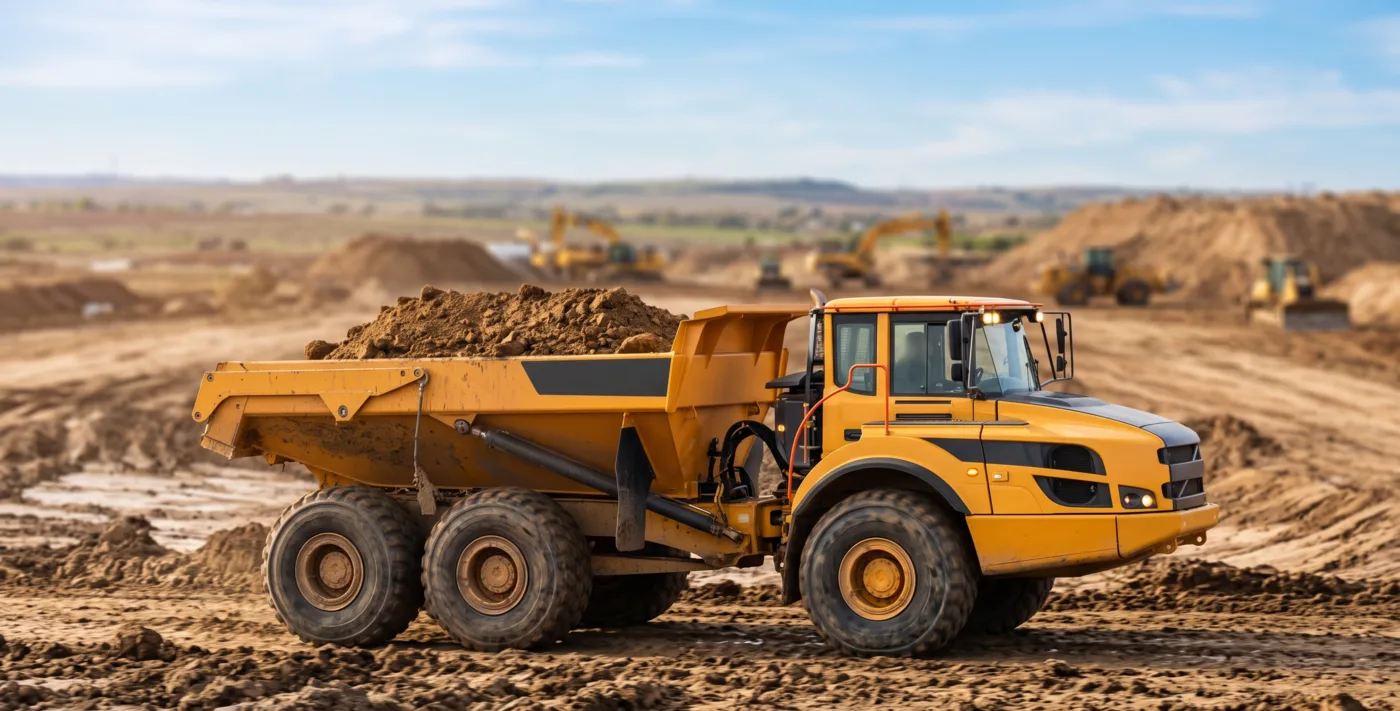
Key takeaways
- Articulated haulers and rigid off-road trucks move 28 to 60 tons or more per cycle, far beyond any road-legal dump truck.
- An articulated hauler is two pieces, cab and dump body, joined by an oscillating pivot that steers the machine and keeps all wheels grounded on rough terrain.
- None of it is road-legal: the widths, axle weights, tires, and speeds all exceed highway rules, so the machines travel between sites on lowboy trailers.
- They solve the cycle inside the site. Import and export through the gate still moves on road-legal trucks: tandems, end dumps, and belly dumps.
- On a job running ADTs, we run the gate: spec fill in, spoil out, matched to the earthwork schedule.
What an articulated hauler is
An articulated dump truck, the ADT, is built as two bodies: a tractor unit with the cab, and a dump body behind, connected by a hydraulic articulation joint. The machine steers by bending at that joint rather than turning its wheels, and the joint also oscillates, letting the front and rear halves roll independently so all six wheels stay planted on ground that would lift a rigid truck’s corner into the air. Six wheel drive, deep off-road tires, and that flexing frame are why an ADT keeps hauling through mud, soft subgrade, and steep haul-road grades. Common classes run about 25 to 45 tons or more per cycle.
What rigid off-road haulers are
The rigid off-road hauler is the quarry and mine pattern: one stiff frame, a steer axle, massive drive tires, and a body built for rock. On a maintained haul road it carries more than an ADT and carries it faster, with the largest site machines in this family running 60 tons and beyond. What it gives up is the ADT’s tolerance for mud, grades, and rough ground; it wants the engineered road the ADT does not need.
Why none of this is road-legal
Every number on these machines exceeds the highway rulebook at once. Bodies run wider than a traffic lane, single axles carry multiples of the 20,000 pound highway limit, the tires are off-road patterns never rated for pavement speeds, and the machines themselves top out far below traffic pace. There is no permit that makes a 40 ton hauler a highway vehicle; when one changes sites, it goes by lowboy. That is the clean line through the whole fleet: inside the fence, earthmoving iron; outside it, trucks built to the road laws.
At a glance
| Spec | Figure |
|---|---|
| Typical volume | Quoted by payload class rather than struck yards |
| Typical payload | 28 to 60 tons or more per cycle |
| Axles | Three axle groups on an articulated frame, or rigid quarry patterns |
| Configuration | Articulated 6×6 hauler, or rigid off-road hauler |
| How it unloads | Dump body tips rearward at the fill or the crusher |
| Best suited to | Mass earthmoving inside the site, off public roads |
Where the road-legal fleet takes over
A big earthwork job is two hauling problems wearing one schedule. The ADTs solve the inside cycle, pit to fill. The gate cycle, spec material coming in and surplus going out, belongs to road-legal trucks: tandems where the access pinches, end dumps for piles at the laydown, and belly dumps when the volume runs long. Cut and fill rarely balances on its own, and the difference between what the site generates and what it needs is exactly the traffic through the gate. Our earthwork calculator reads that balance from real elevation data, and our cut and fill guide explains the shrink and swell behind it.
How we serve ADT jobs
We do not run articulated iron; we run the gate that feeds it, across Dallas-Fort Worth, Austin, San Antonio, and Houston. Import of select fill and base, export of spoil and surplus, scheduled against the earthwork sequence so the inside cycle never starves and the laydown never chokes. Send the balance numbers and the site, and we quote the road side same day.
Articulated and off-road hauler FAQ
Running a mass earthwork job?
Your haulers own the inside cycle. We run the gate: spec fill in, spoil out, quoted same day across DFW, Austin, San Antonio, and Houston.