
Bulk Fill Dirt Delivery to Your Texas Job Site
We source and deliver fill dirt, topsoil, select fill, and sand for construction projects across Texas. Tell us what you need. We handle sourcing, pricing, trucking, and scheduling so your project stays on track.
Four materials. Matched to spec.
Every load is sourced from our vetted supplier network and matched to your project requirements. Density ranges shown are typical. Actual weight varies with moisture and source.
General-purpose fill for grading, backfill, building pads, and elevation changes. The most commonly ordered material for residential and commercial site work.
Screened topsoil for final grade, landscaping, erosion control, and turf establishment. Lighter than fill and typically ordered for the last 4 to 6 inches of a project.
Engineered fill meeting specific plasticity index (PI) and moisture requirements. Required for structural work where compaction and soil performance are tested.
Washed or utility sand for pipe bedding, concrete mixing, base layers, and drainage applications. Available in multiple gradations depending on your spec.
From a few loads to 1M+ yards. We scale to your job.
There is no minimum order. Every job gets a same-day quote, from a few truckloads to a full site. For larger projects like subdivisions, commercial pads, and highway work, we coordinate multi-week and multi-month delivery schedules with dedicated truck queues.
Our average job is 30,000 cubic yards, and we’ve completed projects as large as 1.3 million yards. Daily truck loads average around 200, but we can scale to 600+ loads per day on large sites with the right staging and equipment access.
Standard jobs
Up to 15,000 cubic yards. Commercial pads, master-planned residential, and every smaller order. Typically 3 to 10 day delivery.
Mid-size jobs
15,000 to 50,000 cubic yards. Large commercial, multifamily, subdivisions. 7 to 25 day delivery cadence.
Large projects
50,000 to 1M+ cubic yards. Highway, industrial, major development. 1 month to 1 year scheduling.
Have this info ready and we can price it faster.
- Material type (fill dirt, topsoil, select fill, or sand)
- Estimated volume in cubic yards. Use our soil calculator if needed
- Delivery address or nearest cross streets
- Desired delivery window and any hard deadlines
- Spec requirements if applicable (PI, moisture, proctor density)
- Site access notes (gate hours, flaggers, weight limits)
- Site contact name and phone for truck dispatch coordination
The more detail you provide upfront, the tighter our first quote will be. The more lead time you give us, the better pricing we can offer. We have projects matched up to 12 months out.
Three steps from request to delivery.
Tell us what you need
Submit the form below or call your regional contact directly. Include material type, estimated volume, delivery address, and timeline. We respond same day, usually within a few hours.
We source and price it
We check our supplier network for the closest, most cost-effective source that meets your spec. You get a quote with clear per-yard pricing, delivery costs, and an estimated truck count.
Trucks roll on your schedule
Once approved, we dispatch trucks on your delivery cadence, up to 600+ loads per day on large sites. Our team coordinates with your site contact in real time, adjusting for weather, access changes, and schedule shifts.
What a soil import job looks like.
Every project is different. Here are two common scenarios to give you a sense of how we work and what to expect.
Master-planned subdivision, North Texas
A developer needed 45,000 cubic yards of common fill to build pads across a 120-lot single-family subdivision. We matched the site with two active export sources within 15 miles, staggered delivery across 6 weeks, and coordinated around active utility and grading phases so trucks never conflicted with other trades on site.
Retail ground-up construction, Central Texas
A general contractor needed 15,000 cubic yards of common fill to build up a low-lying commercial retail site before vertical construction could begin. We sourced material from an active residential export project nearby, delivered over 3 weeks, and provided drone topo verification for quantity sign-off.
We deliver across Texas with regional teams in Houston, DFW, Austin, San Antonio, and Central Texas. Haul distance affects pricing. Closer sources mean better rates.
Tell us about your project.
Submit the form and we will get you pricing and a delivery plan, typically same day. For urgent requests, call your regional contact directly.
Regional contacts for import orders
Get a delivery quote
Fill out the details below. The more information you include, the faster and tighter our quote will be.
Need to calculate volume first?
Estimate cubic yards, tonnage, and truck counts before requesting a quote. Takes about 30 seconds.
Use Soil CalculatorBulk Fill Dirt Delivery Near Me in Texas
Looking for fill dirt delivery near you? We do not sell from a yard you have to drive to. We deliver to the job site, so the material comes to your address anywhere across DFW, Austin, San Antonio and Houston, routed from whichever source sits nearest your site that week.
That also means the closest supplier on a map is not automatically the cheapest delivered price, because haul distance is only one input and material grade is the other. Send the address with the material and the yards and we quote the real delivered number for your location.
Importing Fill Dirt to a Texas Job Site
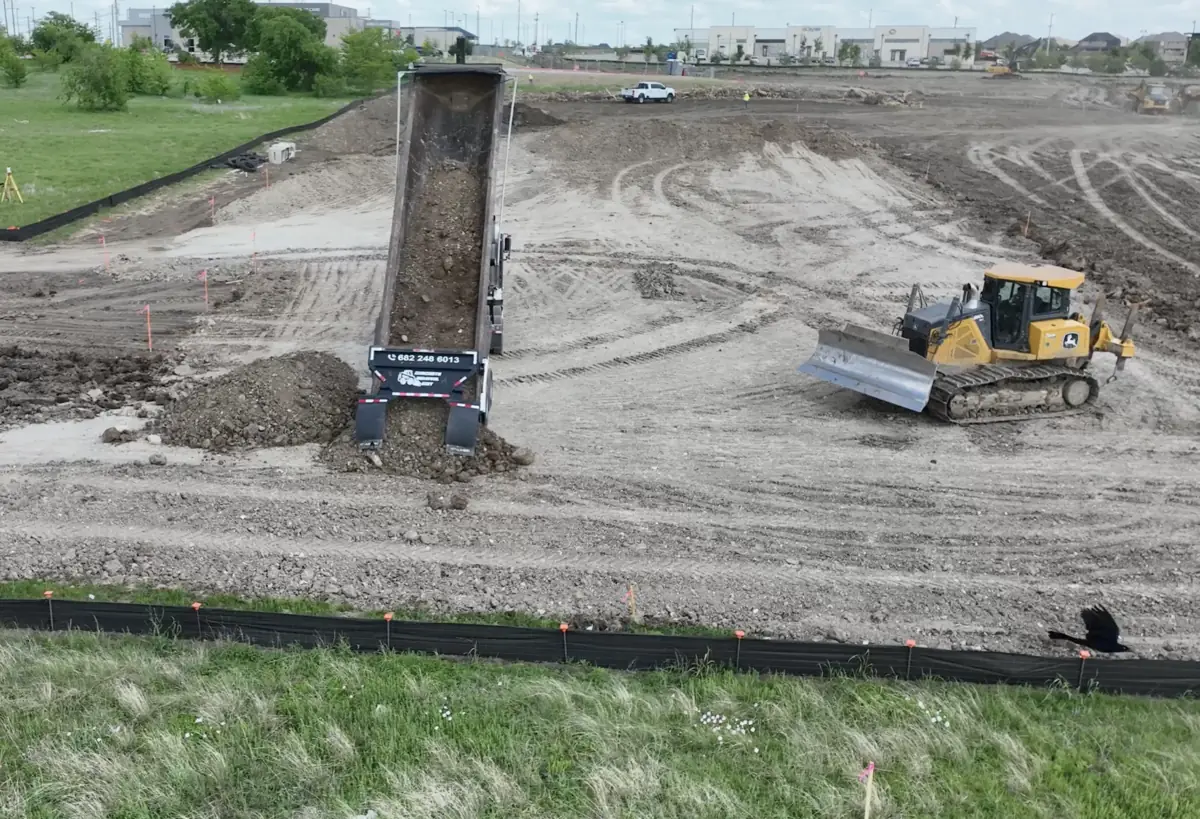
Importing fill means someone has to find material that meets your spec, price it delivered rather than at the pit gate, and keep trucks arriving at the rate your crew can place them. We do all three. Where a job is both cutting and filling, we can pair your import with another site exporting dirt and cut the haul on both ends.
For material specifics see fill dirt, select fill, topsoil and sand and base.
What Bulk Fill Dirt Costs by the Truckload
We price material by the cubic yard and by the truckload, with delivery quoted to the site. The delivered cost moves with the material, the volume and the haul distance, so the honest answer to "how much" is a fast, specific quote rather than a sticker price. See dump truck sizes and load capacities for what each truck carries, or run the volume first if you are still sizing the job.
Common questions about fill dirt delivery
How much does bulk fill dirt delivery cost in Texas?
We price fill dirt by the cubic yard and by the truckload, with delivery quoted to your site. The delivered cost depends on the material, the volume and the haul distance, so the honest answer is a specific quote rather than a sticker price. Send the material, the yards and the job-site location across DFW, Austin, San Antonio or Houston and we turn it around the same day.
Is there bulk fill dirt delivery near me?
If your job site is in Texas, most likely yes. We do not sell out of a yard you have to drive to, we deliver to the job site, so the material comes to your address rather than you hauling it. Routing comes from whichever source sits nearest your site that week, which also means the closest supplier on a map is not automatically the cheapest delivered price. Send the address and the yards and we confirm coverage the same day.
Can you match fill dirt to a geotechnical spec?
Yes. If your geotech report calls for select fill, we match the plasticity index and gradation, commonly TxDOT Item 132 with a PI of 15 or less, and send material documentation with the load. Tell us what the report specifies and we source to it rather than sending general fill and hoping it passes.
How many cubic yards of fill dirt are in a truckload?
It depends on the truck. A tandem dump truck hauls around 12 cubic yards, an end dump around 18 and a belly dump around 22, which is why bulk imports are quoted in loads rather than in bags or buckets. We size the truck to your volume and your site access.
How fast can you deliver fill dirt to a job site?
Quotes come back the same day. Delivery depends on volume and sourcing: standard jobs up to 15,000 cubic yards typically run 3 to 10 days, and larger multi-phase work is scheduled to a daily truck cadence agreed up front. Tell us your date and we build the cadence backwards from it.