
Side Dump Trailer: Capacity, Stability, and Speed
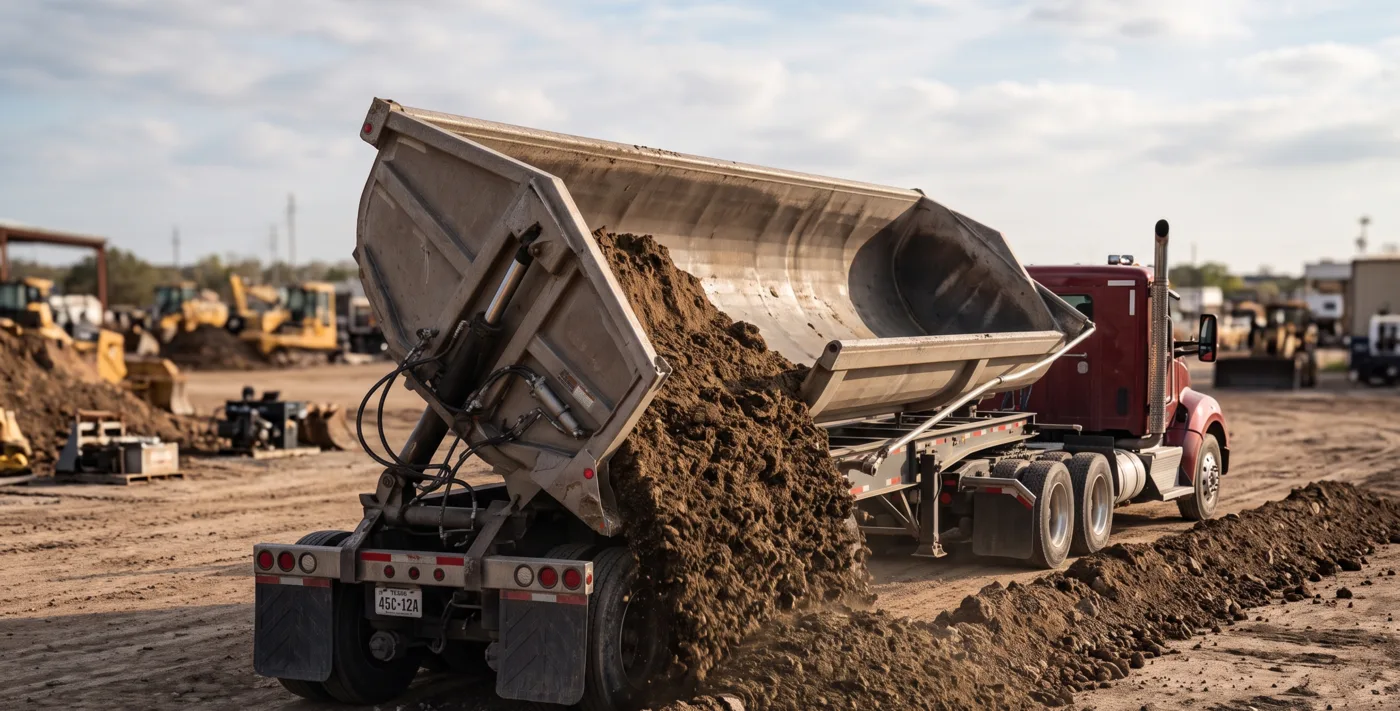
A side dump trailer unloads by rolling its whole tub to one side, putting 21 to 26 cubic yards on the ground in a few seconds while the load never rises overhead. That combination, speed plus stability, is the reason side dumps exist. This guide covers what a side dump holds, how the tipping tub works, why it stays upright on ground that would stop an end dump, and the jobs where it wins. It is part of our complete guide to dump truck sizes and load capacity.
Key takeaways
- A side dump carries about 21 to 26 cubic yards or 22 to 26 tons, with capacity varying by trailer length and axle count more than any other class.
- Hydraulic rams roll the tub sideways and the entire load leaves in seconds, without the driver leaving the cab.
- The load never rises high overhead, so it resists tip-over where a raised end dump is at risk, including soft and uneven ground.
- It places material alongside the truck line, which suits trench backfill, levee lifts, and laying a line while rolling.
- It handles wet, sloppy loads that would hang dangerously high in a raised end dump box.
What a side dump is
A side dump is a semi trailer carrying an open tub cradled between end supports, with hydraulic rams on one side. To unload, the rams extend and roll the tub over until the material slides out beside the trailer. The whole discharge takes a few seconds, the tub rolls back, and the truck is gone. There is no gate to meter and no box to raise; the tub simply pours. Most tubs can dump to either side on trailers plumbed for it, and a rolling dump lays material in a line alongside the travel path.
How many cubic yards and tons does a side dump hold?
About 21 to 26 cubic yards and 22 to 26 tons, depending on the trailer. Side dump tubs come in more lengths and axle configurations than end dumps or belly dumps, so the planning figure is a range, and the same Federal Bridge Formula logic applies: more axles spread farther apart allow more legal gross. When we quote a side dump job we quote the specific trailer’s capacity, not the class average.
Stability: the load stays low
An end dump discharges by lifting tons of material some 30 feet into the air and trusting the ground under the trailer. A side dump never does that. The tub rotates around a low pivot, the center of gravity stays close to the axles through the whole cycle, and the trailer remains essentially as stable unloading as it is rolling. That is why side dumps keep working on soft, rutted, or uneven ground that shuts an end dump down, and why wet, sloppy material that would cling high in a raised box is a side dump load, not an end dump load.
Speed: the cycle-time machine
Discharge in seconds, from the cab, with no raise and no lower, means a side dump spends its day hauling instead of dumping. On short cycles between a borrow pit and a fill, or a stockpile and a levee, the saved minutes per cycle compound into real production, and the truck never stands vulnerable with its box in the air while it does it.
Side dump at a glance
| Spec | Figure |
|---|---|
| Typical volume | About 21 to 26 cubic yards, by trailer |
| Typical payload | About 22 to 26 tons, by trailer and axles |
| Axles | Varies with the trailer; more axles allow more gross |
| Configuration | Tractor plus side-tipping tub trailer |
| How it unloads | Rams roll the tub sideways; the whole load leaves in seconds |
| Best suited to | Fast cycle times, placement along a line, soft or uneven ground |
How many side dump loads is your project?
Divide your loose cubic yards by the truck’s capacity and round up, because a partial load still ships as a load. Order by loose yards, not compacted yards; fill shrinks under compaction, so a finished pad needs more loose yards delivered than its compacted volume.
| Project volume | Loads at 21 cy | Loads at 26 cy |
|---|---|---|
| 100 cubic yards | 5 loads | 4 loads |
| 250 cubic yards | 12 loads | 10 loads |
| 500 cubic yards | 24 loads | 20 loads |
| 1,000 cubic yards | 48 loads | 39 loads |
When the side dump is the right truck
Choose it when the material must land beside the truck rather than behind or under it: backfill along a trench or wall line, lifts along a levee or embankment, and lines laid while rolling. Choose it when the ground will not carry an end dump raise, and when cycle time is the number the job lives on. A belly dump still wins metered windrows between the wheel lines and carries a touch more on the top trailers, and an end dump still wins the dense pile at a point. Side dumps are also a smaller share of the Texas bulk fleet than end dumps and belly dumps, so on short notice availability can decide.
How we dispatch side dumps
We plan side dumps where placement or ground conditions call for them across Dallas-Fort Worth, Austin, San Antonio, and Houston. Tell us the material, the yards, and where the load has to land, and we match the trailer and quote the loads same day.
Side dump FAQ
Placing along a line, or on soft ground?
Side dumps put the load beside the truck and keep working where end dumps cannot raise. We quote loads same day across DFW, Austin, San Antonio, and Houston.