
Transfer Dump Truck: Two Boxes, One Driver
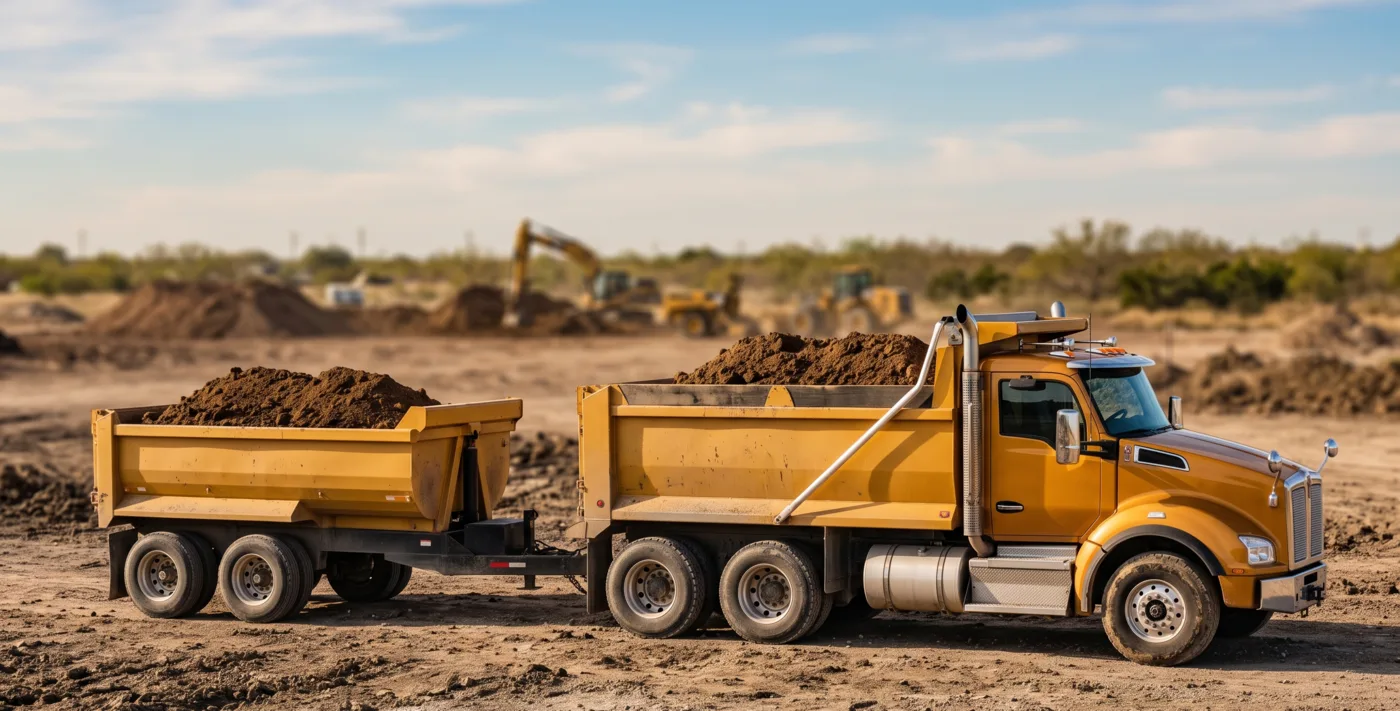
A transfer dump truck is a powered dump truck towing a second material box on a trailer. The truck dumps its own bed, the empty bed receives the transfer box rolling forward on rails, and that box dumps too: 26 to 40 or more cubic yards moved by one driver, with the placement agility of a straight truck at the moment of the dump. This guide covers how the transfer works, what the combination carries, and when it beats a semi end dump. It is part of our complete guide to dump truck sizes and load capacity.
Key takeaways
- A transfer set carries about 26 to 40 or more cubic yards and 25 to 40 tons across its two boxes, moved by one driver and one power unit.
- The lead truck dumps in place like a big tandem; the transfer box then rolls forward on rails into the emptied bed and dumps the same way.
- Drop the trailer and the lead truck works gates and corners no semi can, then hooks back up for the next round.
- The transfer needs a level spot and about a minute to swap the box between dumps.
- Its edge is payload per driver hour with placement flexibility; on simple open-site bulk, a belly dump does the tonnage with less complexity.
What a transfer dump truck is
The configuration was born in western paving markets that wanted semi-class payload without giving up the straight truck’s ability to place a load. A transfer set is two pieces: a powered dump truck with its own bed, and a trailer carrying a second box, the transfer box, on rollers. Each box discharges rearward in place, exactly like a rigid truck, because at the moment of dumping each box is sitting in the truck’s bed.
How the transfer actually works
The truck dumps its own bed first. It then pulls ahead on a level spot, lines the empty bed up with the trailer, and the transfer box rolls forward on rails out of the trailer frame and locks into the bed, moved by a cable or powered drive in about a minute. The truck dumps the second box, rolls it back onto the trailer, and the set is ready to load again. When a site is truly tight, the driver drops the trailer at the gate, works the lead truck alone like a tandem with a bigger appetite, and hooks back up on the way out.
How many cubic yards and tons does a transfer haul?
The two boxes together commonly hold about 26 to 40 or more cubic yards, moving 25 to 40 tons across 5 to 6 axles, with the exact split depending on the box pair. The federal axle limits, the 80,000 pound gross ceiling, and the Bridge Formula govern the combination like any other rig; the transfer’s trick is not extra legal weight, it is keeping one driver productive across two boxes while preserving in-place dumping.
Transfer dump at a glance
| Spec | Figure |
|---|---|
| Typical volume | About 26 to 40 plus cubic yards across two boxes |
| Typical payload | About 25 to 40 tons combined |
| Axles | 5 to 6, truck plus transfer trailer |
| Configuration | Powered dump truck towing a rolling transfer box |
| How it unloads | Each box dumps rearward, in place, from the truck’s bed |
| Best suited to | More payload per driver while keeping straight-truck placement |
How many transfer loads is your project?
Divide your loose cubic yards by the truck’s capacity and round up, because a partial load still ships as a load. Order by loose yards, not compacted yards; fill shrinks under compaction, so a finished pad needs more loose yards delivered than its compacted volume.
| Project volume | Loads at 26 cy | Loads at 40 cy |
|---|---|---|
| 100 cubic yards | 4 loads | 3 loads |
| 250 cubic yards | 10 loads | 7 loads |
| 500 cubic yards | 20 loads | 13 loads |
| 1,000 cubic yards | 39 loads | 25 loads |
When the transfer is the right truck
Jobs that need volume and placement at once: paving and base work where material must land in place at multiple points, routes where a driver shortage makes payload per driver the controlling number, and sites whose inner reaches take a straight truck but whose daily tonnage wants a semi. It asks for a level staging spot and a minute per swap in exchange.
On simple bulk moves across open ground, the extra moving parts stop paying. A belly dump hauls comparable tonnage and spreads it as it rolls, and an end dump piles it with nothing to align. A super dump covers the same in-place mission with one box when the volume fits.
How we dispatch transfers
Transfer sets are a specialty piece in Texas bulk work, and we plan them where the job profile earns them across Dallas-Fort Worth, Austin, San Antonio, and Houston. Send the material, the yards, and the placement points, and we quote the right configuration same day.
Transfer dump FAQ
Volume and placement on one ticket?
If the job wants semi-class yards placed like a straight truck, we quote the right configuration same day across DFW, Austin, San Antonio, and Houston.