
Tri-Axle and Quad Dump Trucks: More Axles, More Payload
A tri-axle dump truck is a tandem with a third axle added; a quad carries a fourth. Each additional axle spreads the load over more wheels and more length, so the law allows more weight: 14 to 20 cubic yards and 16 to 26 tons, from a rigid truck that still dumps in place and still fits where semis cannot. This guide covers what the extra axles buy, what these trucks carry, and when they beat both the tandem below them and the bigger iron above. It is part of our complete guide to dump truck sizes and load capacity.
Key takeaways
- Tri-axle and quad dump trucks carry about 14 to 20 cubic yards or 16 to 26 tons, the step between a tandem and a super dump.
- The added axles are usually liftable: down under load to spread weight legally, up when empty to save tires and tolls.
- More axles and a slightly longer span raise both the axle group limits and the Bridge Formula allowance; a quad clears more than a tri.
- The truck stays rigid, short, and placeable, dumping in place on sites a combination cannot enter.
- Exact legal payload swings with axle spacing and enforcement rules, so we size the load to the route, not just the truck.
What tri-axle and quad dump trucks are
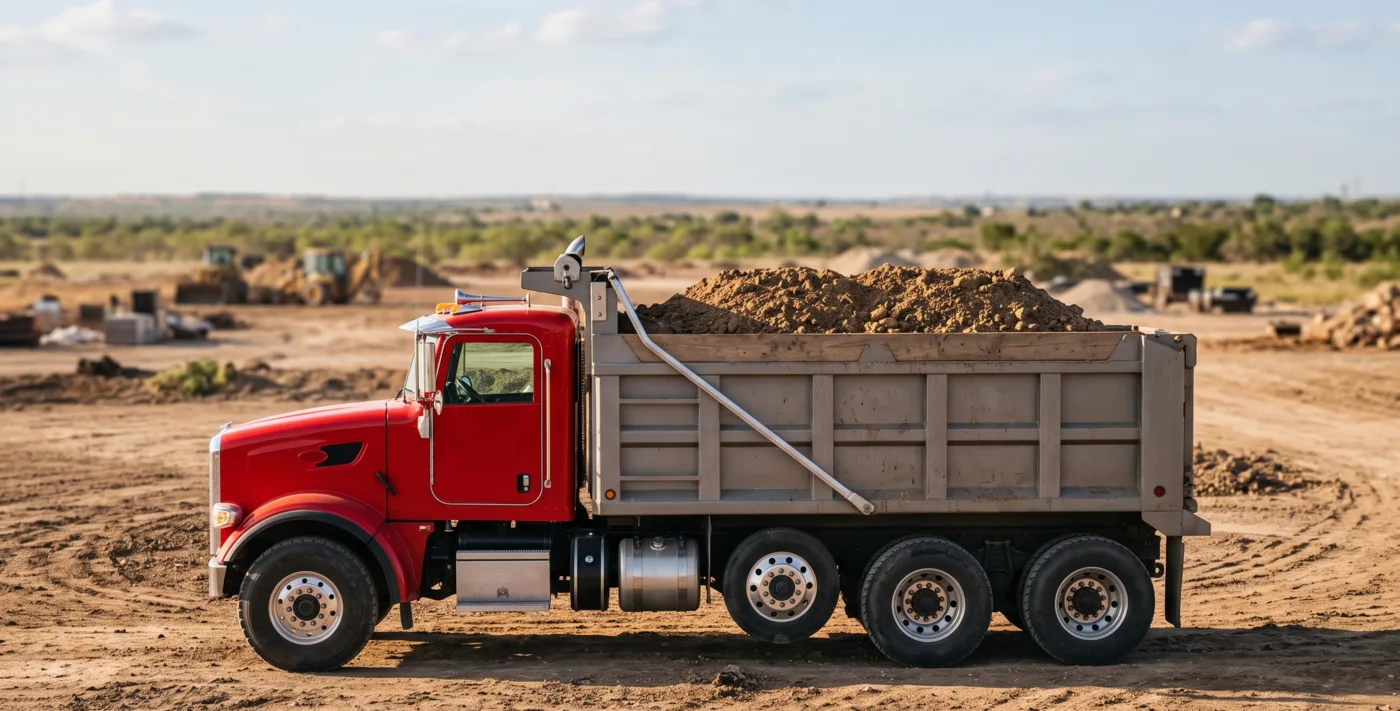
Both start from the same bones as a tandem: one rigid chassis, a dump bed, a steer axle, and a rear tandem group. A tri-axle adds one more axle, a quad two more, mounted as liftable pusher axles ahead of the tandem or tag axles behind it. Under load the lift axles drop and carry their share; empty, they rise clear of the road so the truck steers, turns, and wears like the shorter machine it started as.
How many cubic yards and tons do they carry?
About 14 to 20 cubic yards and 16 to 26 tons, with the tri-axle at the lower end of the envelope and the quad at the top. The mechanism is the same one that governs every truck on this page: federal law caps each axle group, and the Federal Bridge Formula caps each span by its length and axle count. A four axle rigid spanning about 22 feet computes near 56,500 pounds gross against roughly 51,000 for a three axle tandem, and a quad stretches further still. Against an empty weight in the mid 20,000s, each added axle converts to several thousand pounds of legal payload.
Tri-axle and quad at a glance
| Spec | Figure |
|---|---|
| Typical volume | About 14 to 20 cubic yards |
| Typical payload | About 16 to 26 tons |
| Axles | 4 (tri-axle) or 5 (quad), with liftable pushers or tags |
| Configuration | Rigid truck, extra liftable axles on a tandem chassis |
| How it unloads | Raises its own bed and dumps rearward, in place |
| Best suited to | Bigger legal loads than a tandem with the same short, placeable body |
How many tri-axle or quad loads is your project?
Divide your loose cubic yards by the truck’s capacity and round up, because a partial load still ships as a load. Order by loose yards, not compacted yards; fill shrinks under compaction, so a finished pad needs more loose yards delivered than its compacted volume.
| Project volume | Loads at 14 cy | Loads at 20 cy |
|---|---|---|
| 100 cubic yards | 8 loads | 5 loads |
| 250 cubic yards | 18 loads | 13 loads |
| 500 cubic yards | 36 loads | 25 loads |
| 1,000 cubic yards | 72 loads | 50 loads |
When the extra axles pay off
When the site still demands a rigid truck but the tandem’s 12 yards would run the load count out of hand. Urban infill with real volume, staged commercial pours of fill and base, and hauls where in-place dumping is non-negotiable all sit in the tri and quad’s lane: two to twelve more tons per trip through the same gate. When the tonnage climbs further and the running surface allows it, the super dump takes the same mission to the 80,000 pound ceiling, and when the site opens up, the end dump and belly dump economics return.
How we dispatch tri-axles and quads
We size rigid-truck hauls to the access, the tonnage, and the route across Dallas-Fort Worth, Austin, San Antonio, and Houston. Tell us the material, the yards, and the gate, and we send the truck whose axle count the job actually earns, quoted same day.
Tri-axle and quad FAQ
Rigid truck, bigger loads?
When the gate takes a straight truck but the volume outruns a tandem, we quote tri-axle and quad loads same day across DFW, Austin, San Antonio, and Houston.