
Volteo de Fondo: Yardas, Toneladas y el Cordón
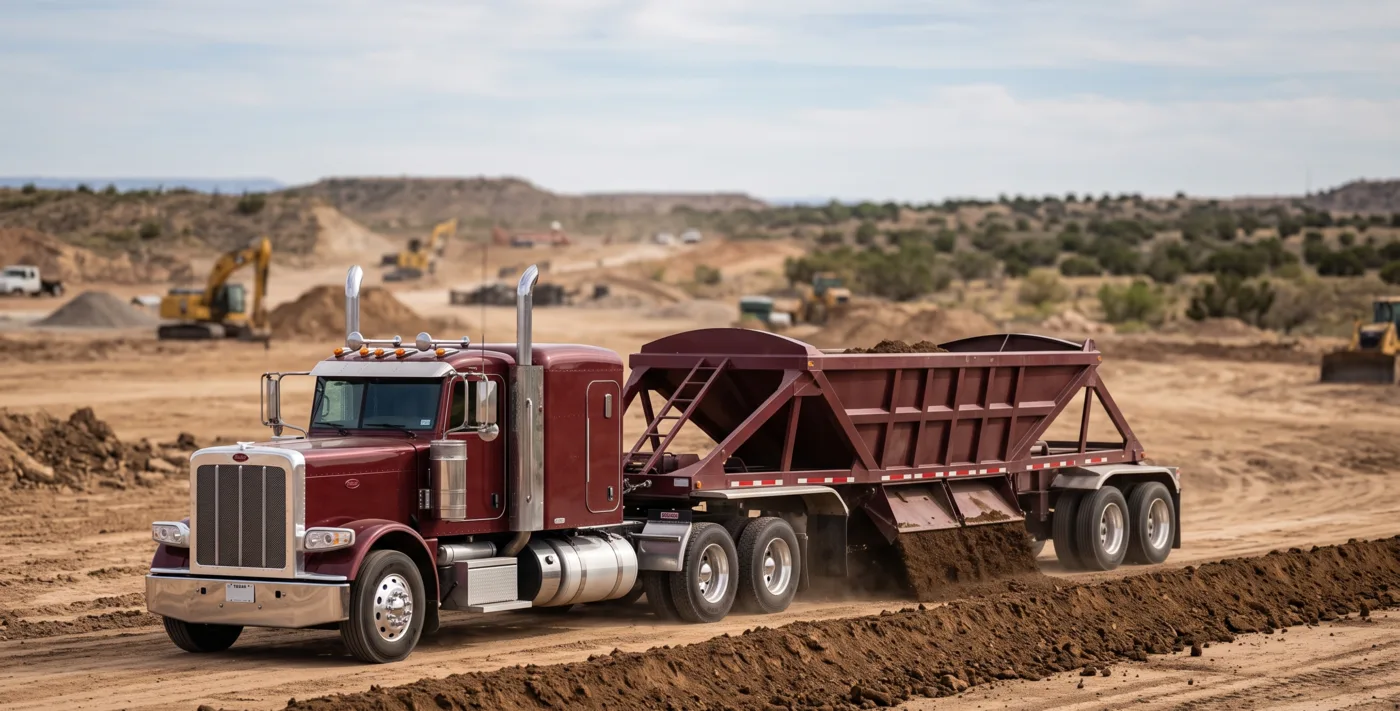
The belly dump, or bottom dump, is the volume king of road-legal dirt hauling: about 22 cubic yards or 24 tons per load, discharged through a clamshell gate in the belly of the trailer as the truck rolls forward, laying material in a controlled ribbon called a windrow. This guide covers what a belly dump holds, how the gate works, why its 5 to 7 axles raise the legal load, and which jobs it wins. It is part of our complete guide to dump truck sizes and load capacity.
Key takeaways
- A belly dump carries about 22 cubic yards or 24 tons, the largest routine road-legal load in bulk dirt hauling.
- A clamshell gate under the trailer meters the load into a windrow as the truck rolls, built for spread placement rather than piles.
- Five to seven axles spread over a long trailer raise what the Federal Bridge Formula allows, which is where the extra payload comes from.
- Nothing raises: the trailer stays low while it unloads, so there is no overhead risk and no tip-over exposure on marginal ground.
- It needs run room. On open sites, long hauls, and high volume it is the cheapest yard moved; in a tight yard it has no move to make.
What a belly dump is
A belly dump is a semi trailer with a hopper-shaped box and a hydraulic clamshell gate at the bottom. Instead of tipping, it opens the gate and lets gravity pull the load straight down while the truck rolls forward, so the material lands in a continuous ribbon between the wheel lines: the windrow. The driver controls the gate opening and the ground speed, which together set how thick and how long the windrow runs, and a practiced operator can lay a remarkably even line ready for a blade or dozer to spread.
It can stand still and drop, but the discharge lands under the trailer between the axles, so a standing drop mostly buries its own gate. The moving windrow is the point of the machine. For a dense pile placed at a spot, an end dump is the right tool.
How many cubic yards does a belly dump hold?
About 22 loose cubic yards is the planning figure for bulk dirt and aggregate, quoted heaped in the hopper. That is roughly 600 cubic feet per trip, and on light dry material the hopper genuinely fills. On typical moist fill dirt at 2,300 to 2,700 pounds per yard the load runs right at the legal weight, which is what the axle count is for.
How many tons, and why the axle count matters
About 24 tons. The Federal Bridge Formula allows more weight on axle groups that are more numerous and spread farther apart, and a belly dump is exactly that: a long trailer with five, six, or seven axles under it. The extra axles and the longer outer span raise the legal gross beyond what a standard five axle end dump runs at the same length, and the low, centered hopper keeps the load stable while it does it.
The windrow is the advantage
Spread work is where the belly dump earns its keep. Road base and flex base laid in windrows down a road section or a pad lets the blade crew pull and grade the material directly, with no pile-knockdown pass, and lime or cement treatment work wants the same even ribbon. On long linear jobs, levees, haul roads, and big pads, the belly dump keeps rolling while it unloads, so cycle times stay tight and the material lands distributed instead of stacked. High volume plus long highway haul plus spread placement is the belly dump trifecta.
Belly dump at a glance
| Spec | Figure |
|---|---|
| Typical volume | About 22 cubic yards, heaped |
| Typical payload | About 24 tons |
| Axles | 5 to 7, spread along the combination |
| Configuration | Tractor plus bottom-gate hopper trailer |
| How it unloads | Clamshell belly gate lays a windrow as the truck rolls |
| Best suited to | High volume on open sites, spread placement, long highway hauls |
How many belly dump loads is your project?
Divide your loose cubic yards by the truck’s capacity and round up, because a partial load still ships as a load. Order by loose yards, not compacted yards; fill shrinks under compaction, so a finished pad needs more loose yards delivered than its compacted volume.
| Project volume | Belly dump loads (22 cy) |
|---|---|
| 50 cubic yards | 3 loads |
| 100 cubic yards | 5 loads |
| 250 cubic yards | 12 loads |
| 500 cubic yards | 23 loads |
| 1,000 cubic yards | 46 loads |
| 2,000 cubic yards | 91 loads |
When the belly dump is the right truck
Open ground, real volume, and material that wants to be spread. If the site can give a 70 foot combination room to keep moving, the belly dump delivers the lowest cost per yard in the fleet and hands the grading crew a head start. It is also the calm choice on marginal ground, because nothing ever rises overhead.
It is the wrong truck for piles, pits, and tight yards. It cannot back its load over an edge the way an end dump can, it has no answer for a constrained gate the way a tandem does, and a side dump beats it where the material must land beside the truck line instead of under it.
How we dispatch belly dumps
Belly dumps carry our high-volume and spread-placement work across Dallas-Fort Worth, Austin, San Antonio, and Houston. Tell us the material, the yards, and the site, and if the job wants windrows we plan the lay lines with your grading crew and quote the loads same day.
Belly dump FAQ
High volume on open ground?
Windrows for the blade crew or bulk yards on a long haul, we quote belly dump loads same day across DFW, Austin, San Antonio, and Houston.