
Volteo Semirremolque: Yardas, Toneladas y Dónde Trabaja
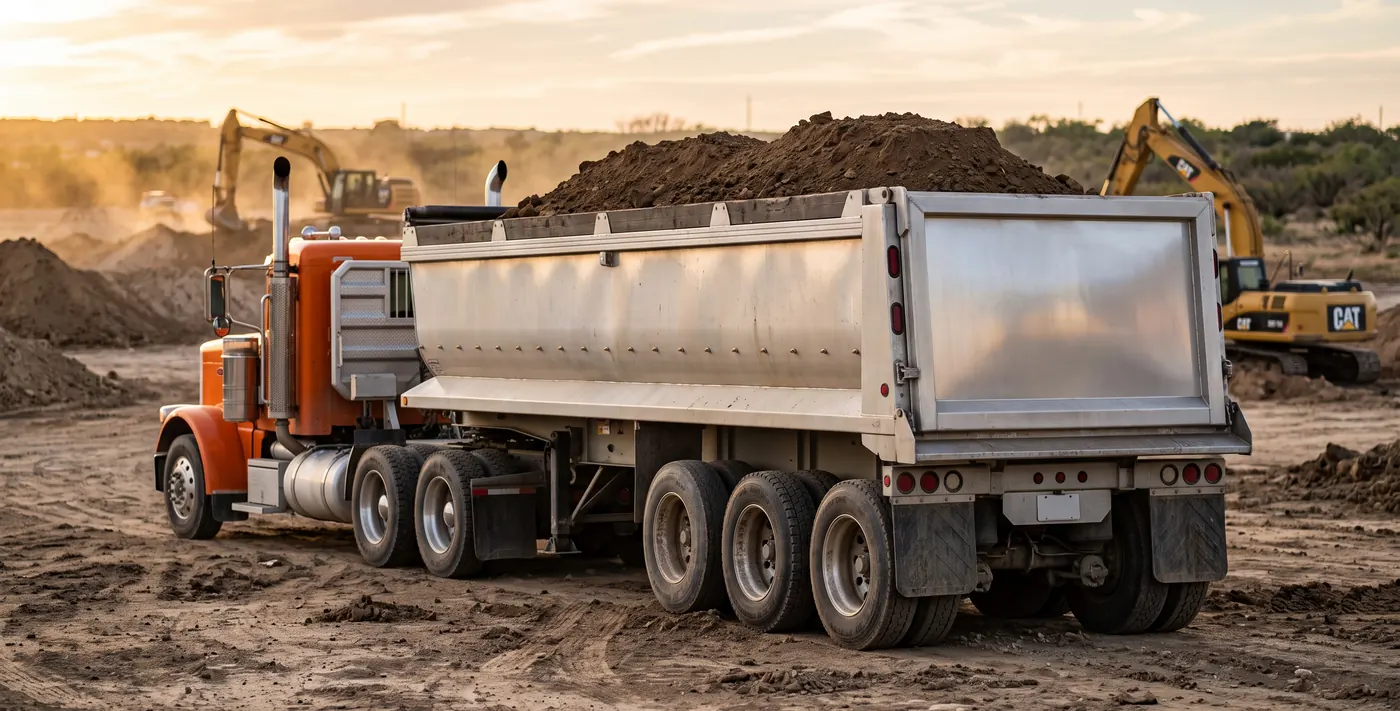
The end dump semi is the everyday default of commercial dirt hauling: a tractor pulling a dump trailer that raises at the front and discharges out the back, about 18 cubic yards or 22 tons at a time, dropped as one full pile exactly where the site wants it. This guide covers what an end dump holds, where the 80,000 pound federal limit puts its payload, why it demands firm, level ground to raise, and when a different truck wins. It is part of our complete guide to dump truck sizes and load capacity.
Key takeaways
- An end dump semi carries about 18 cubic yards or 22 tons per load, the standard unit of commercial site work.
- Five axles: a steer, the tractor’s drive tandem, and the trailer’s tandem, governed by the federal 80,000 pound gross ceiling.
- The payload is what the law leaves over: 80,000 pounds gross minus a 30,000 to 34,000 pound empty rig is 46,000 to 50,000 pounds of dirt.
- It needs firm, level ground and clear overhead to raise, because a lifted trailer carries its load high and can go over on soft or sloped ground.
- Once a site has room for a semi, the end dump’s cost per yard beats a tandem; on spread placement and long open hauls a belly dump beats it.
What an end dump is
An end dump is a combination: a road tractor pulling a separate dump trailer with a hydraulic hoist at the front of the box. At the site, the hoist tips the whole trailer body up and the load slides out the rear gate as one pile. Trailers commonly run 28 to 40 feet, and the combination stretches to roughly 65 to 70 feet, which is what buys the capacity a rigid truck cannot carry. Most bulk dirt trailers are frameless, meaning the box itself is the structure, which trims empty weight and turns directly into legal payload.
How many cubic yards does an end dump hold?
About 18 loose cubic yards is the planning figure for bulk dirt and aggregate across Texas, quoted heaped. That is close to 500 cubic feet of material in one trip. Trailer boxes vary, and light material can heap to the full volume, but on dirt the figure that closes the load is almost always weight, not the box.
How many tons, and the 80,000 pound math
On the Interstate system a five axle rig is capped at 80,000 pounds gross, 20,000 pounds on a single axle, and 34,000 pounds on each tandem group, with the Federal Bridge Formula policing the spacing. An empty tractor and dump trailer weigh about 30,000 to 34,000 pounds, so the legal payload is the remainder, 46,000 to 50,000 pounds, which is why the end dump’s planning number is about 22 tons. Wet clay at up to 3,100 pounds per loose yard can weigh the rig out with the box visibly short of full; clean dry select fill loads closer to the full 18 yards.
Why an end dump needs firm, level ground
The price of rear discharge is the raise. At full lift the box top reaches around 30 feet up, and until the load breaks loose, tons of material ride high above the trailer axles. On soft, uneven, or sloped ground that is a tip-over waiting for a lean, and wet, sticky clay that hangs in the top of the box makes it worse by holding weight high on one end. So we check the dump pad before we commit the truck: bearing, level, and overhead. Power lines, tree limbs, and canopies all sit inside a raised trailer’s reach, and the truck also needs pull-forward room as the pile clears the gate.
End dump at a glance
| Spec | Figure |
|---|---|
| Typical volume | About 18 cubic yards, heaped |
| Typical payload | About 22 tons |
| Axles | 5: steer, drive tandem, trailer tandem |
| Configuration | Tractor plus dump trailer, roughly 65 to 70 feet overall |
| How it unloads | Hoist tips the trailer, load discharges rearward as one pile |
| Best suited to | General commercial site work, the default for most deliveries and haul-off |
How many end dump loads is your project?
Divide your loose cubic yards by the truck’s capacity and round up, because a partial load still ships as a load. Order by loose yards, not compacted yards; fill shrinks under compaction, so a finished pad needs more loose yards delivered than its compacted volume.
| Project volume | End dump loads (18 cy) |
|---|---|
| 50 cubic yards | 3 loads |
| 100 cubic yards | 6 loads |
| 250 cubic yards | 14 loads |
| 500 cubic yards | 28 loads |
| 1,000 cubic yards | 56 loads |
| 2,000 cubic yards | 112 loads |
When the end dump is the right truck
It is the volume default for a reason. When a commercial site has room for a semi to enter, set up, and pull forward, an end dump delivers the most useful combination in dirt work: a big legal payload dropped as one dense pile at a point you choose. It loads fast under an excavator on export work, and it backs to an edge, so fill can go over a slope or into a cut that a belly dump could never reach.
It is the wrong truck when the gate is tight, the ground will not carry a raise, or the job wants material spread rather than piled. A tandem takes the constrained sites, and a belly dump lays a windrow for blade crews and carries a few more yards while it does it.
How we dispatch end dumps
The end dump is the workhorse of our delivery and haul-off dispatch across Dallas-Fort Worth, Austin, San Antonio, and Houston. Send the material, the yards, and the site, and we confirm the access and the dump pad and quote the loads same day.
End dump FAQ
Commercial volume to move?
Delivery in or haul-off out, we quote end dump loads same day across DFW, Austin, San Antonio, and Houston.