
Camión Tandem de Volteo (10 Ruedas): Yardas, Toneladas y Dónde Cabe
A tandem dump truck, the 10-wheeler, is the shortest and most maneuverable truck in bulk dirt hauling, and the one we send when the site itself is the constraint. It carries about 12 cubic yards or 14 tons per load, dumps in place by raising its own bed, and fits entrances and streets that a 70 foot semi combination cannot touch. This guide covers what a tandem holds, the axle math behind its legal load, how many loads your volume takes, and when a bigger truck beats it. It is part of our complete guide to dump truck sizes and load capacity.
Key takeaways
- A tandem dump truck carries about 12 cubic yards or 14 tons of dirt per load, and on dense or wet material the weight limit fills before the bed does.
- The name counts the axles: one steer axle plus a tandem pair at the rear. Ten wheels total, two up front and eight in dual pairs behind.
- Its legal gross lands around 51,000 pounds on a typical wheelbase, set by the 34,000 pound tandem group limit and the Federal Bridge Formula.
- At about 25 feet long it enters, turns, and dumps where semi combinations cannot: tight residential access, urban infill, and staged deliveries.
- The cost per yard runs higher than an end dump or belly dump, so the tandem is the truck access chooses, not volume.
What a tandem dump truck is
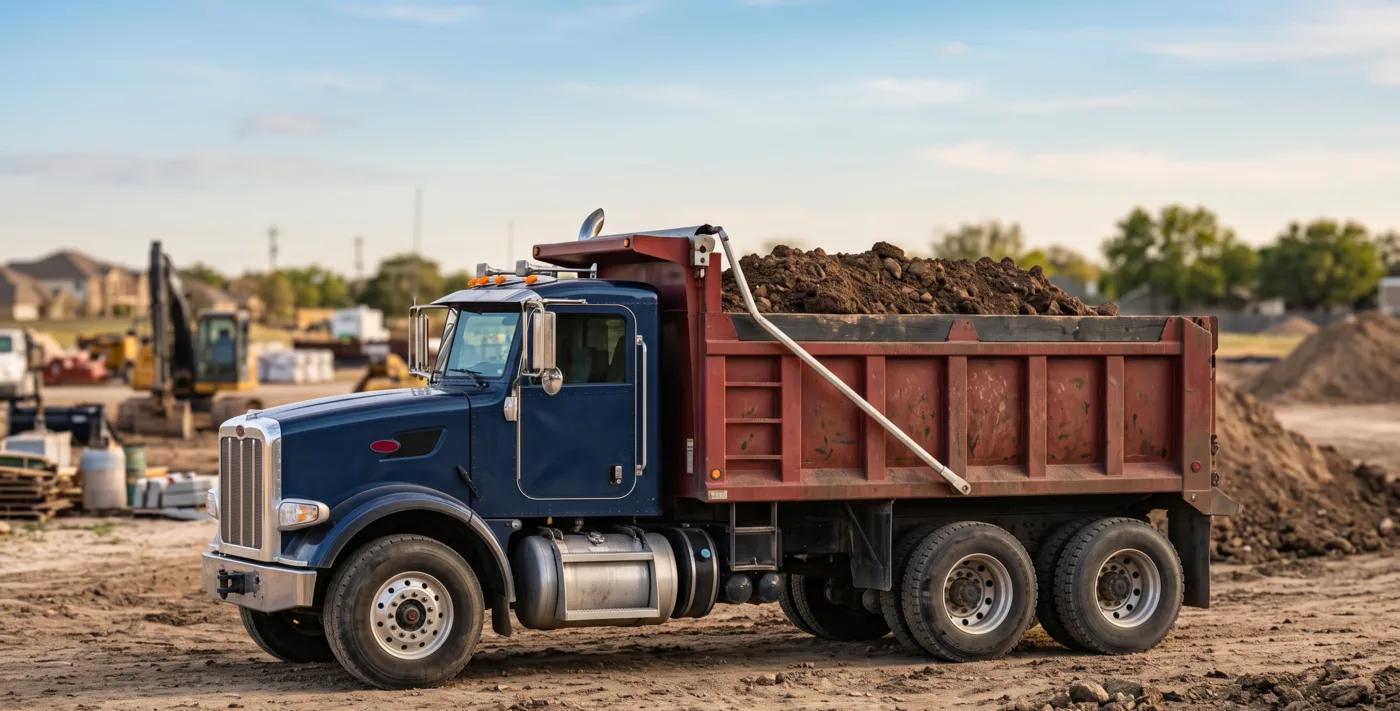
A tandem dump truck is a single rigid machine: cab, frame, and dump bed on one chassis, with a hydraulic hoist that raises the bed and discharges the load rearward, in place. The tandem in the name is the paired axle group at the rear, two axles set close together that share the load. Add the steer axle and you get three axles and ten wheels, which is why the trade calls it a 10-wheeler. Because the bed is part of the truck, a tandem does not jackknife, backs precisely, and dumps without the long, firm runway a raised semi trailer needs.
The bed commonly runs 14 to 16 feet long and the truck about 25 feet overall. That footprint is the tandem’s whole argument. It clears a gate that a combination cannot, turns inside a cul-de-sac, and puts the load where the work is instead of where the truck fits.
How many cubic yards does a tandem hold?
About 12 loose cubic yards of dirt or aggregate is the planning figure, quoted heaped, with the material mounded above the bed sides at its natural angle of repose. A cubic yard is 27 cubic feet, so a tandem load is roughly 325 cubic feet of material. Light, dry material like screened topsoil can ride close to the full heap. Dense or wet material cannot, because the truck reaches its legal weight first, and that is the number that actually closes the bed.
How many tons can a tandem carry, and why
About 14 tons, and the ceiling is legal, not mechanical. Federal rules allow 20,000 pounds on a single axle and 34,000 pounds on a tandem axle group, and the Federal Bridge Formula caps the whole vehicle by its axle count and spacing, which for a short three axle truck works out to about 51,000 pounds gross. An empty tandem weighs about 23,000 to 26,000 pounds, and what remains is the payload: roughly 25,000 to 28,000 pounds, or about 12.5 to 14 tons.
Run the material math and volume and weight meet almost exactly. A cubic yard of fill dirt weighs about 2,300 to 2,700 pounds, so 12 yards of typical moist fill is roughly 14 tons. That is no coincidence; the bed is sized so a full heap of dirt lands on the legal limit. On heavy wet clay the load weighs out a yard or two early, and on light dry topsoil the bed fills first. Our soil calculator runs both checks with these exact numbers.
Tandem dump truck at a glance
| Spec | Figure |
|---|---|
| Typical volume | About 12 cubic yards, heaped |
| Typical payload | About 14 tons |
| Axles | 3: one steer plus a rear tandem group |
| Configuration | Rigid truck, bed and cab on one frame, about 25 feet overall |
| How it unloads | Raises its own bed and dumps rearward, in place |
| Best suited to | Tight or residential access, urban infill, staged and smaller loads |
How many tandem loads is your project?
Divide your loose cubic yards by the truck’s capacity and round up, because a partial load still ships as a load. Order by loose yards, not compacted yards; fill shrinks under compaction, so a finished pad needs more loose yards delivered than its compacted volume.
| Project volume | Tandem loads (12 cy) |
|---|---|
| 50 cubic yards | 5 loads |
| 100 cubic yards | 9 loads |
| 250 cubic yards | 21 loads |
| 500 cubic yards | 42 loads |
| 1,000 cubic yards | 84 loads |
| 2,000 cubic yards | 167 loads |
Past roughly 100 yards the load count is telling you to look at a bigger truck if the site can take one. An end dump moves the same 250 yards in 14 loads instead of 21, and a belly dump does it in 12.
When the tandem is the right truck
Access decides first. Narrow entrances, residential street approaches, low overhead, tight turning, short staging aprons: a tandem gets into and out of constrained sites that stop a 70 foot combination cold. Placement decides second. It raises its bed inside a small footprint and drops a precise pile, which suits staged deliveries, backfill drops along a foundation, and several small placements across one site. Ground bearing decides third, because a loaded tandem puts less total weight on soft ground than a loaded combination.
It is the wrong truck for bulk volume on an open site. Once a commercial pad has room for a semi to set up, an end dump or belly dump moves far more material per hour and lowers the cost per yard, so the tandem count that made sense at 60 yards stops making sense at 600.
How we dispatch tandems
We deliver and haul off bulk dirt with tandems across Dallas-Fort Worth, Austin, San Antonio, and Houston, usually for tight-access deliveries, staged placements, and smaller volumes. Tell us the material, the yards, and the gate, and we match the truck to the access and quote the loads same day.
Tandem dump truck FAQ
Tight site? Size the truck to it.
Tell us the material, the yards, and the access, and we quote tandem loads same day across DFW, Austin, San Antonio, and Houston.