
Tamaños de Camiones de Volteo y Capacidad de Carga de Tierra
A dump truck is how bulk dirt actually moves, and the truck you load decides how many cubic yards ride per trip, how many trips your project takes, what it weighs on the road, and what can even reach your site. Soil Depot delivers and hauls off bulk dirt across DFW, Austin, San Antonio, and Houston. This guide covers what each truck holds in cubic yards and tons, how much a yard of each material weighs, the federal and Texas weight limits that cap a legal load, how to turn a project into truckloads, and which truck fits a tight residential-access site versus an open commercial pad.
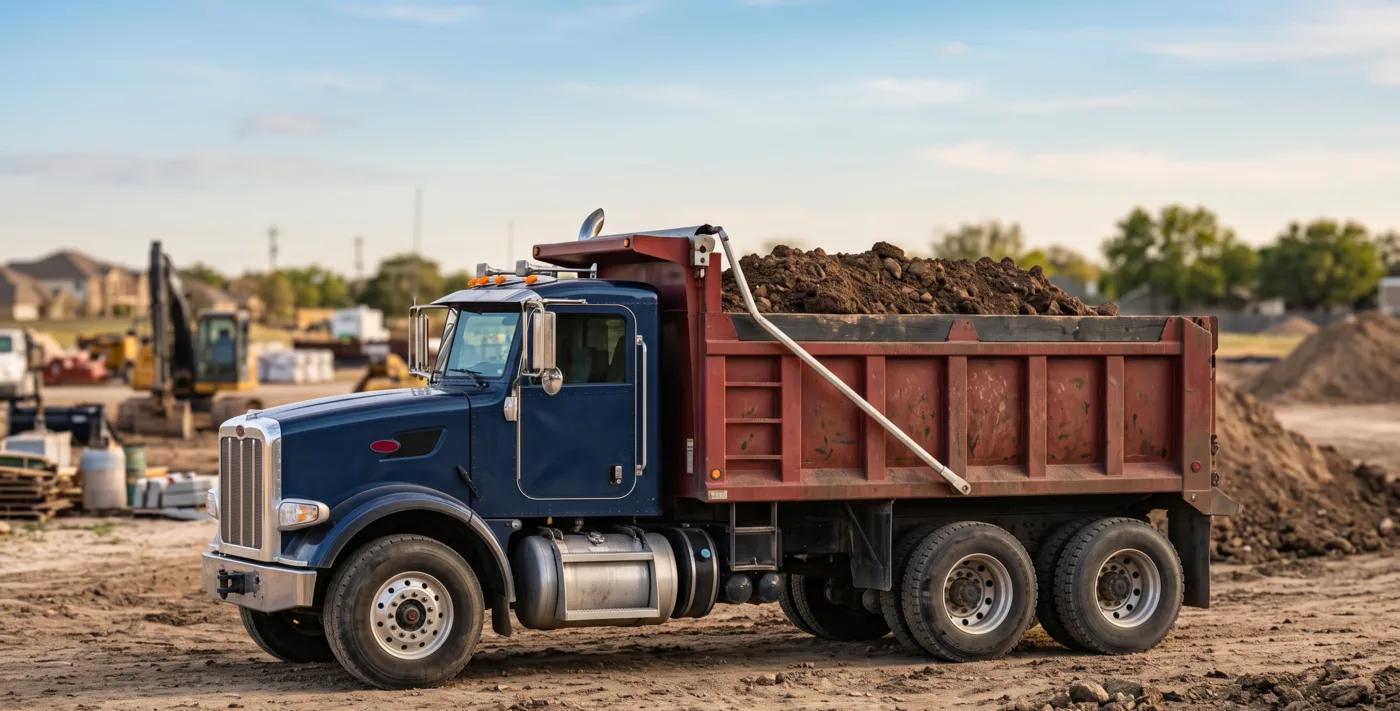
Tandem dump truck (10-wheeler)
Rigid · dumps rearward
A single rigid truck, cab and bed on one frame, that raises its own bed to dump in place. Short and maneuverable, it is the truck for tight or residential-access sites and smaller staged loads.
Full tandem guide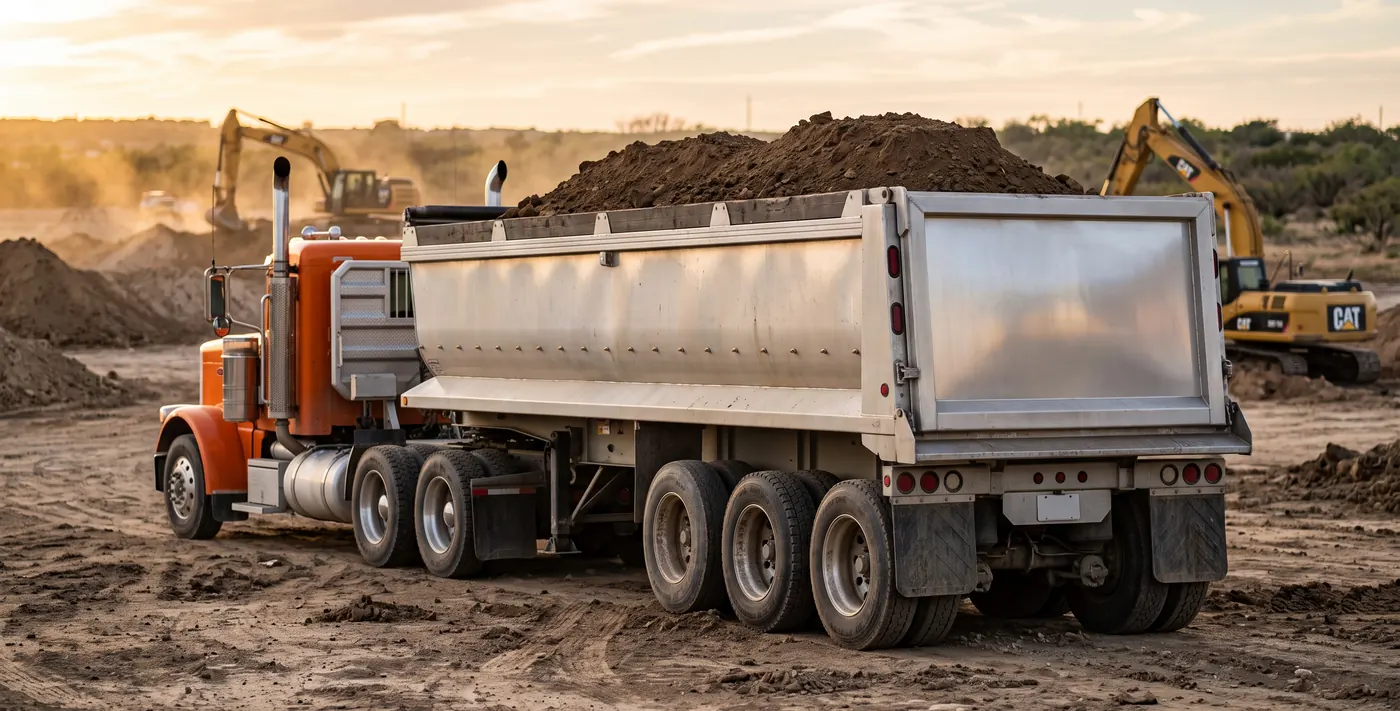
End dump semi
Tractor + trailer · dumps rearward
A tractor pulling a dump trailer that raises the front to discharge out the back. The everyday default for commercial site work, dropping a full pile in one spot. Needs firm, level ground to lift a loaded trailer.
Full end dump guide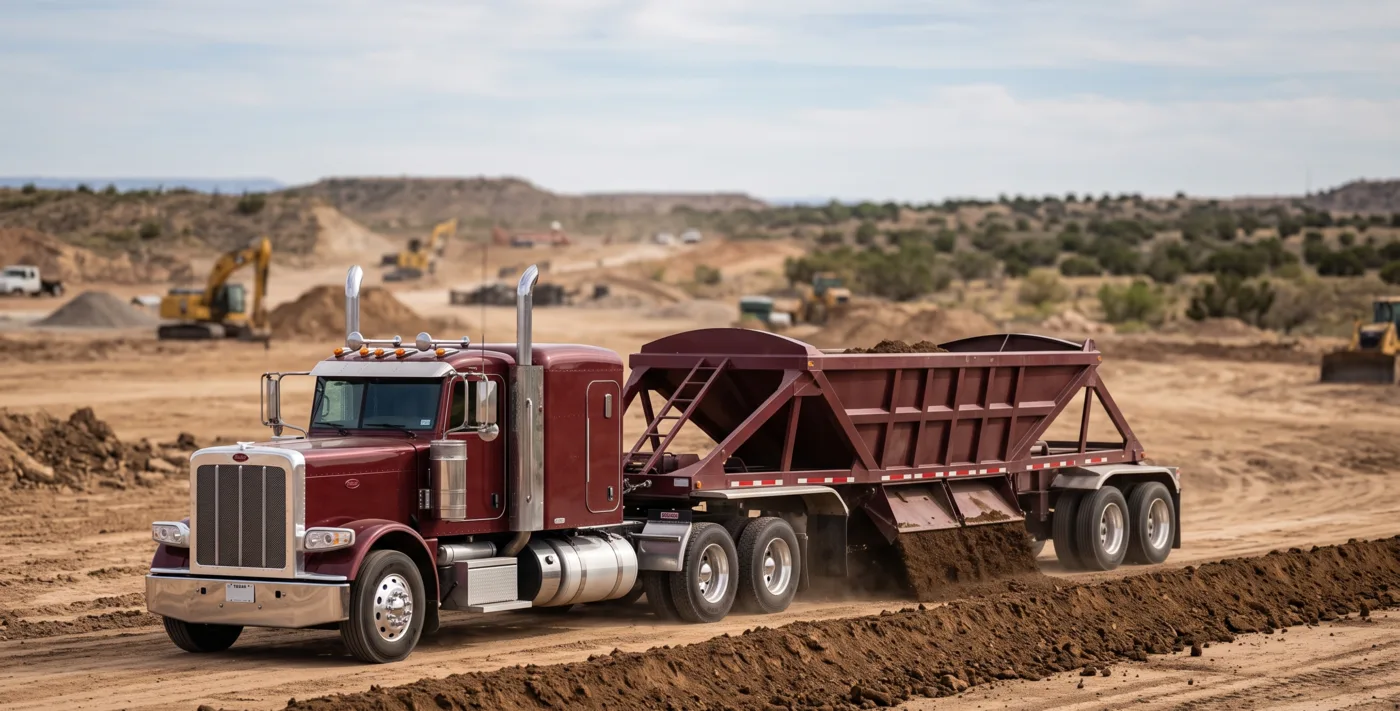
Belly dump (bottom dump)
Drops through the belly gate
A clamshell gate in the belly of the trailer lays material in a windrow as the truck rolls forward. Carries the most and is the most efficient for high volume, spread placement, and long highway hauls on open sites with room to move.
Full belly dump guide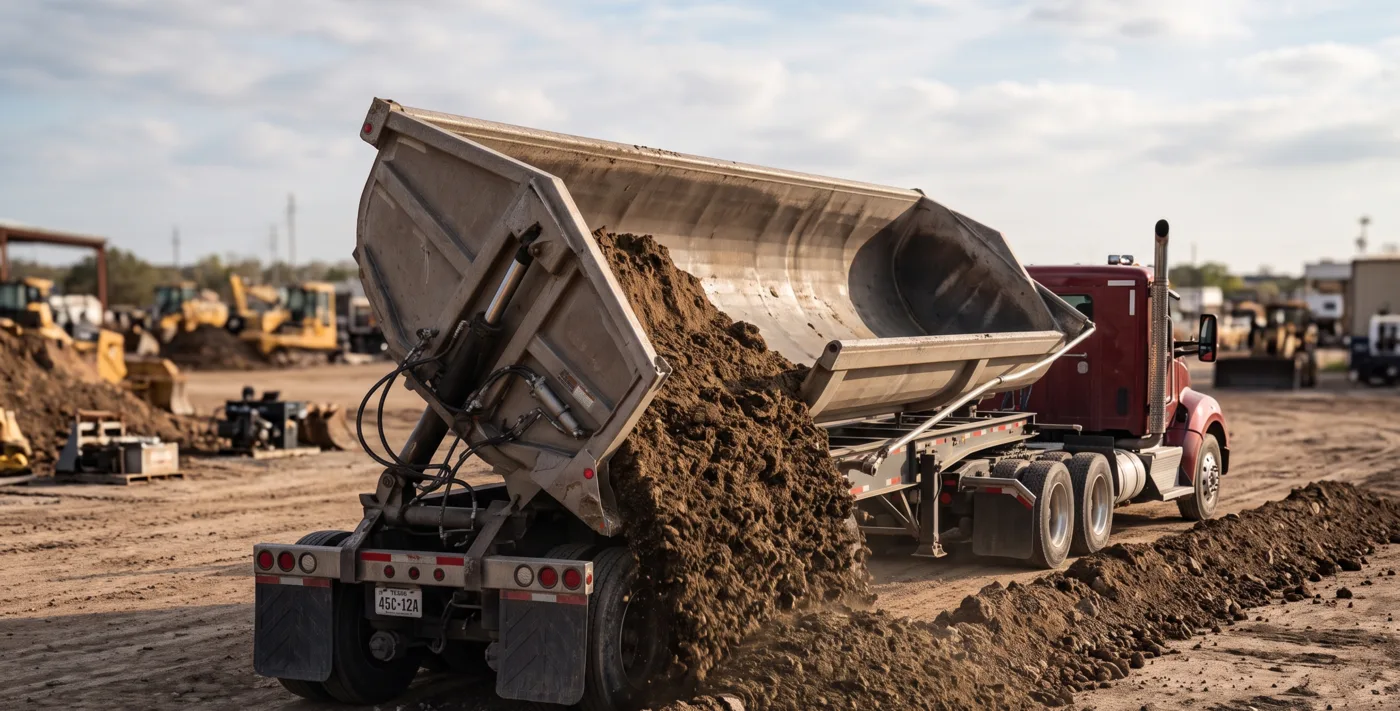
Side dump trailer
Semi · tips to the side
Tips its tub to one side to unload the whole load in seconds and resists tip-over better than a raised end dump, since the load never rises high overhead. Good for fast cycle times and laying material along a line. Capacity varies with the trailer.
Full side dump guide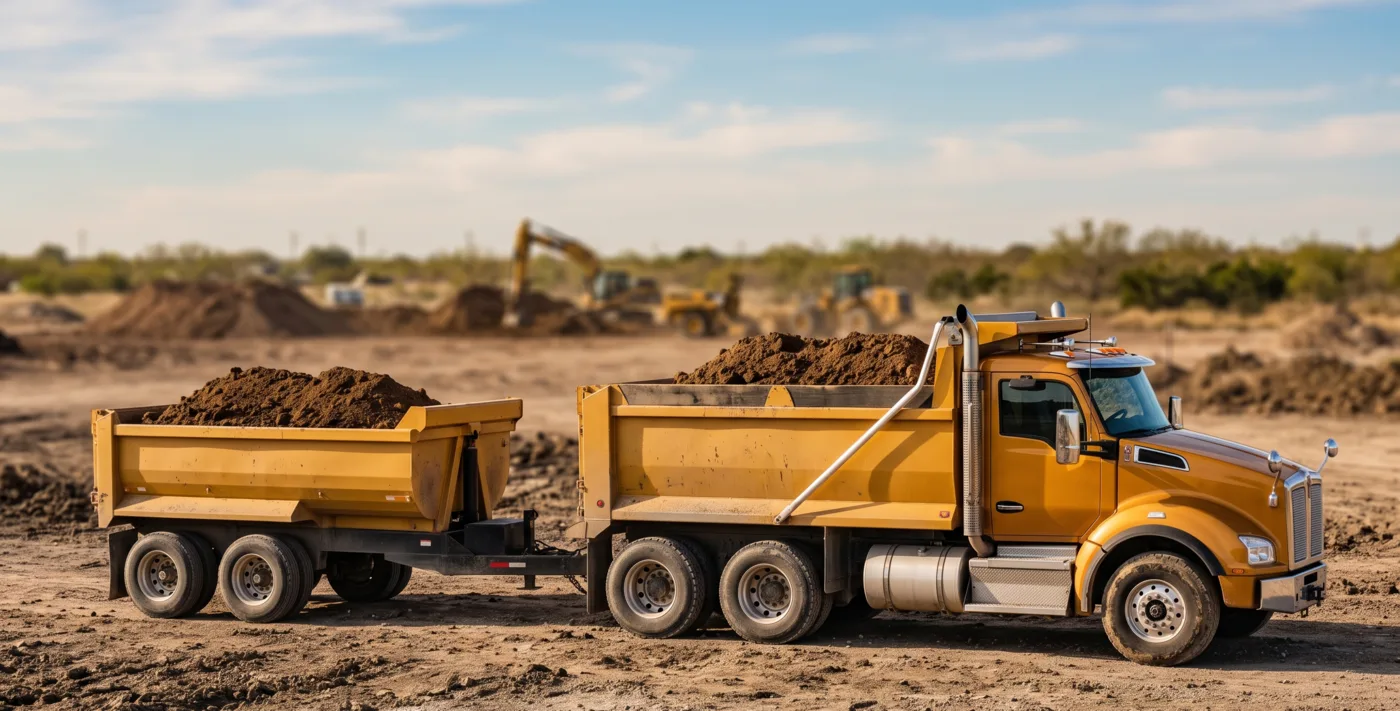
Transfer dump truck
Truck + trailing transfer box
A powered dump truck that tows a second box. After the truck dumps, the transfer box rolls into the empty bed and dumps too, so one driver moves more total legal payload while staying maneuverable. The two boxes together commonly hold about 26 to 40 or more cubic yards.
Full transfer guide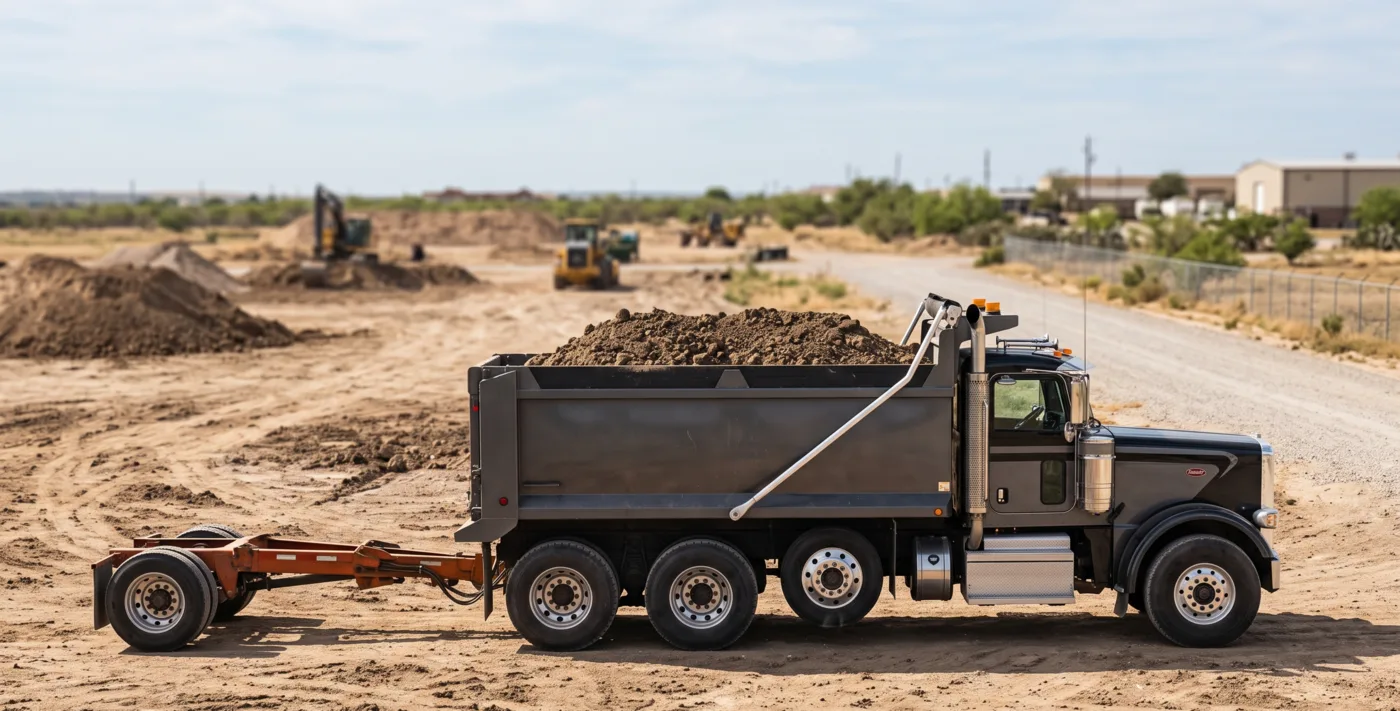
Super dump
Rigid · liftable trailing axle
A rigid truck fitted with a liftable trailing axle that lowers under load to stretch the axle spacing, so the Federal Bridge Formula allows a higher legal gross. It carries close to an end dump’s tonnage while still dumping in place like a tandem.
Full super dump guide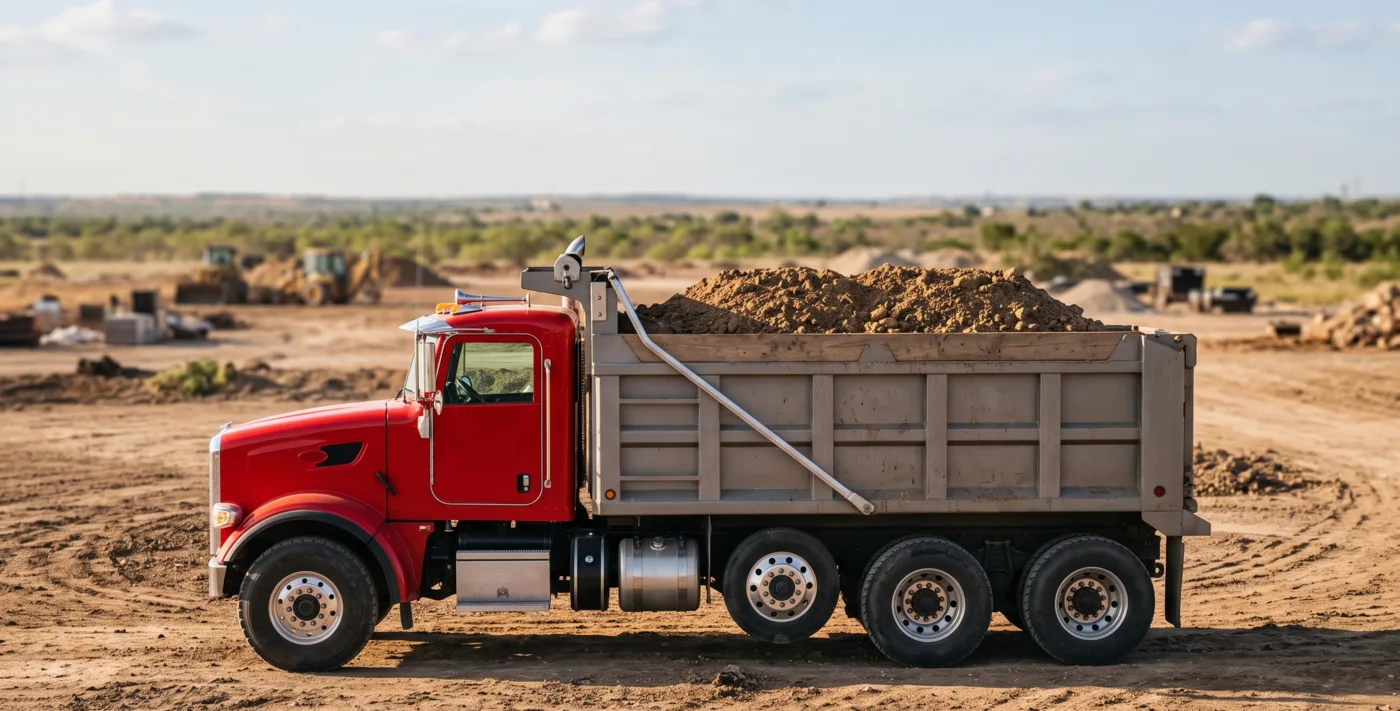
Tri-axle and quad dump
Rigid · extra rear axles
A rigid dump truck with a third or fourth rear axle added to raise the legal payload. More capacity than a tandem while keeping the in-place dump and the shorter, more placeable rigid body. A quad carries more than a tri-axle.
Full tri-axle and quad guide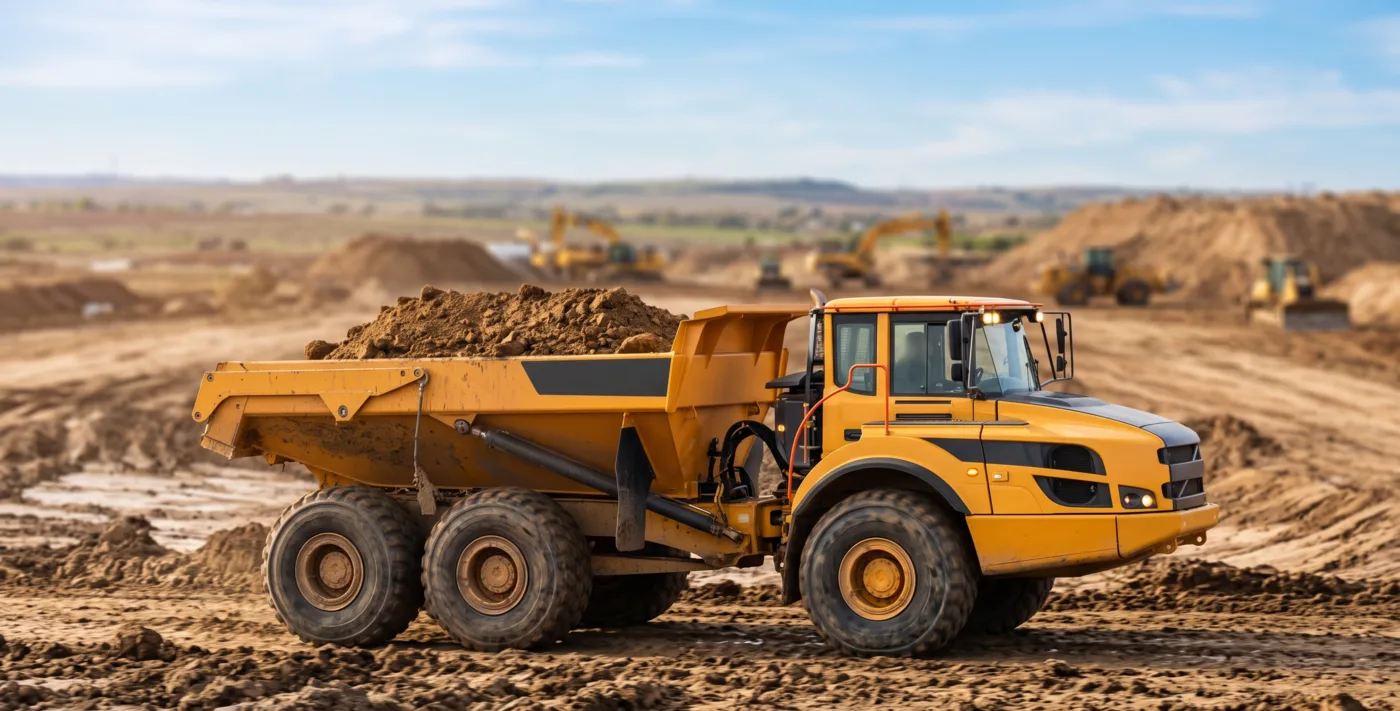
Articulated and off-road haulers
Off-road only · not road-legal
On earthmoving sites away from public roads, articulated haulers (a cab and dump body joined by a pivot) and rigid off-road haulers move 28 to 60 tons or more over rough ground. They are not road-legal, so they are not used for public-road delivery or haul-off.
Full off-road hauler guideKey takeaways
- A tandem dump truck (10-wheeler) carries about 12 cubic yards or 14 tons. An end dump (semi) carries about 18 cubic yards or 22 tons. A belly dump carries about 22 cubic yards or 24 tons.
- Dirt is heavy, so the weight limit usually fills before the bed does. A cubic yard of fill dirt weighs roughly 2,300 to 2,700 pounds, and wet clay weighs more.
- Federal law caps a loaded rig at 20,000 pounds on a single axle, 34,000 pounds on a tandem axle, and 80,000 pounds gross, with the Federal Bridge Formula governing axle spacing.
- Texas follows those federal limits on Interstates. On state highways a purchased annual TxDMV tolerance permit allows about 5 percent more, roughly 84,000 pounds gross, and heavier divisible loads move under a TxDMV over-axle or over-gross permit.
- Order by loose yards, not compacted yards. Fill shrinks when it is compacted, so a pad needs more loose yards delivered than its finished volume.
- These are the exact capacities and material densities built into our soil calculator, so your estimate and your haul plan use the same numbers.
How many cubic yards are in a dump truck load?
It depends on the truck. In bulk dirt and aggregate hauling across Texas the three workhorses are the tandem, the end dump, and the belly dump, and they carry roughly 12, 18, and 22 cubic yards per load. A cubic yard is 27 cubic feet, about the volume of a large washing machine, so an 18 cubic yard end dump moves close to 500 cubic feet of material in a single trip. These are typical planning capacities, not exact bed dimensions, because the real load a truck can legally carry is set as much by weight as by volume.
Heaped capacity vs struck capacity
Bed volume is quoted two ways. Struck capacity is the volume level with the top of the bed sides, a flat cut across the box. Heaped capacity is the volume with the material mounded above the sides at its natural angle of repose, which is how granular material actually rides. The cubic yard figures above are practical heaped loads for dirt and aggregate. How much a bed truly holds depends on the material: dry sand mounds and heaps well, while wet clay slumps and rides closer to struck. Either way, on dense material the truck reaches its legal weight before the heaped volume is ever reached, which is why tonnage, not just yardage, decides the load.
How many tons of dirt does a dump truck haul?
Volume tells you how much fits in the bed. Weight tells you what the truck is legally allowed to carry, and with dirt the weight limit almost always comes first. A tandem hauls about 14 tons, an end dump about 22 tons, and a belly dump about 24 tons. Because a single cubic yard of fill dirt weighs well over a ton, a truck loaded with dense or wet material reaches its legal gross weight before the bed looks full. That is why the same end dump that carries 18 loose yards of dry, light material may be capped a few yards short on heavy, saturated clay. When we size a haul we check both the volume and the tonnage and quote the number of loads that actually clears the road-legal limit.
How much does a cubic yard of dirt weigh?
Material weight per cubic yard is the reason loads weigh out. The figures below are loose, as-delivered densities, and wet material runs heavier than dry. These are the same densities our soil calculator uses to convert yards to tons and to size truckloads.
| Material | Weight per cubic yard (loose) | Tons per cubic yard |
|---|---|---|
| Topsoil (screened) | 2,000 to 2,400 lb | 1.00 to 1.20 |
| Fill dirt | 2,300 to 2,700 lb | 1.15 to 1.35 |
| Select fill | 2,400 to 2,800 lb | 1.20 to 1.40 |
| Sand | 2,600 to 3,000 lb | 1.30 to 1.50 |
| Flex base, road base, crushed concrete | 2,700 to 3,100 lb | 1.35 to 1.55 |
| Wet Blackland clay (native) | 2,500 to 3,100 lb | 1.25 to 1.55 |
Dump truck types explained
Dump trucks are named for how they are built and how they discharge. A handful of configurations do almost all bulk dirt and aggregate hauling, and the differences decide how much each carries, how it unloads, and where it can work. The three that move most of the bulk dirt in Texas are the tandem, the end dump, and the belly dump. Capacities below are typical planning figures for dirt and aggregate; the exact load is capped by the material weight and the road limits covered further down. Each card links to the full guide for that truck: what it holds, the legal weight math, load counts by project volume, and when to use it.
For public-road delivery and haul-off, the tandem, end dump, and belly dump cover most of the work, and the right one depends on your volume, your material, and your site access. Size a real quantity with the soil calculator, which uses these same truck capacities to turn your yards into a load count.
Dump truck capacity and weight limits at a glance
| Truck type | Typical volume | Typical payload | Typical axles | Best suited to |
|---|---|---|---|---|
| Tandem (10-wheeler) | 12 cubic yards | 14 tons | 3, rigid | Smaller loads, tight or residential-street access, urban infill, staged deliveries |
| End dump (semi) | 18 cubic yards | 22 tons | 5, tractor and trailer | General commercial hauling, the default for most site work |
| Belly dump | 22 cubic yards | 24 tons | 5 to 7 | High volume on open pads, spread placement, long highway hauls |
| Side dump | 21 to 26 cubic yards | 22 to 26 tons | 5, tractor and trailer | Fast, stable unloading, laying material along a line, high cycle counts |
| Transfer dump | 26 to 40 plus cubic yards (two boxes) | 25 to 40 tons | 5 to 6, truck plus transfer trailer | Moving more legal payload with one power unit while staying maneuverable |
| Super dump | 19 to 26 cubic yards | 19 to 26 tons | Rigid with a liftable trailing axle | Near end-dump payload while still dumping in place |
| Tri-axle or quad dump | 14 to 20 cubic yards | 16 to 26 tons | 4 to 5, rigid | Bigger legal load than a tandem, still short and placeable |
Tandem vs end dump vs belly dump: which truck for the job?
The right truck matches your volume, your material, and how much room the site gives a truck to work. Use a tandem when the load is smaller or the access is tight, because it is the one that reliably gets into and out of a constrained site. Use an end dump for most commercial deliveries, where you want a full pile dropped in one place and the site has room for a semi to set up. Use a belly dump when the volume is high, the haul is long, or you want the material spread as it is laid rather than piled, and the site is open enough for a long trailer to keep moving.
Material weighs into the choice. Dense or wet dirt weighs out early, so several loads of a smaller truck can beat fewer loads that each run light against the legal limit. Clean, dry select fill, road base, or sand loads closer to the truck’s full volume. Tell us the material, the yards, and the site, and we match the fleet to it.
Which truck fits your site: tight residential access vs open commercial pads
Access is often the deciding factor, and it comes down to how much room a truck has to enter, turn, and dump. On a site with tight residential-street access, narrow entrances, urban infill, limited staging, or overhead and turning limits, a tandem gets in and out where a seventy foot semi combination cannot, even though it carries less per trip. On an open commercial pad with room to turn, stage, and set up, an end dump or belly dump moves far more material per hour and lowers the cost per yard. We look at the approach, the turning radius, the ground bearing under a loaded truck, the overhead clearance, and the drop location before we commit a truck, so the load actually reaches the placement point instead of getting stuck at the gate or sinking in soft ground. When access is truly tight we stage material or shuttle with smaller trucks so the work still gets fed.
How many truckloads will my project take?
Divide your total loose cubic yards by the truck’s capacity and round up, because a partial load still ships as a load. The table below shows the truckloads for common volumes across these three trucks. Fewer, larger loads usually cost less per yard, but only when the site can take the bigger truck.
| Project volume | Tandem (12 cy) | End dump (18 cy) | Belly dump (22 cy) |
|---|---|---|---|
| 50 cubic yards | 5 loads | 3 loads | 3 loads |
| 100 cubic yards | 9 loads | 6 loads | 5 loads |
| 250 cubic yards | 21 loads | 14 loads | 12 loads |
| 500 cubic yards | 42 loads | 28 loads | 23 loads |
| 1,000 cubic yards | 84 loads | 56 loads | 46 loads |
| 2,000 cubic yards | 167 loads | 112 loads | 91 loads |
Loose yards, bank yards, and compacted yards
Dirt occupies different volumes in three states, and mixing them up is the most common ordering mistake. Bank yards are the volume in the ground, undisturbed. Loose yards are the volume after it is dug and loaded, which is larger because excavation adds air, an effect called swell. Compacted yards are the volume after it is placed and rolled, which is smaller than even the bank volume because compaction drives the air back out. Trucks are loaded and material is sold by the loose yard, so you order by loose yards, and you order more loose yards than your finished compacted volume. The swell and shrink below are typical values our calculator uses; your geotechnical report sets the real numbers for a spec job.
| Material | Swell, bank to loose | Typical compaction shrink, loose to compacted |
|---|---|---|
| Sand | about 12 percent | about 8 percent |
| Topsoil | about 20 percent | about 10 percent |
| Select fill | about 18 percent | about 20 percent |
| Fill dirt | about 25 percent | about 15 percent |
| Flex base, crushed base | about 20 percent | about 22 percent |
| Blackland clay (native) | about 30 percent | high, plasticity index 40 to 60 |
You do not have to run the math by hand. Our soil calculator turns a length, width, and depth into loose cubic yards, tons, and truckloads using these exact truck capacities and densities, our earthwork calculator works cut and fill from real elevation data, and our guide on how much fill dirt you need walks through the compaction and waste allowance. Then send it over and we quote the loads same-day.
Federal and Texas truck weight limits
The reason a dump truck weighs out before it cubes out is the law. Loaded weight is capped by axle limits, by a gross vehicle weight ceiling, and by how the axles are spaced, and Texas layers its own rules on top of the federal ones.
Federal axle and gross weight limits
On the federal Interstate system the standard limits are 20,000 pounds on a single axle, 34,000 pounds on a tandem axle group, and 80,000 pounds gross vehicle weight. Subtract the empty weight of the truck and trailer, commonly around 30,000 to 34,000 pounds for a five axle rig, from that 80,000 pound ceiling, and what is left is the legal payload, which is why a legal five axle end dump commonly carries about 22 tons of dirt. Add axles, as a tri-axle or a belly dump does, and you raise the legal payload because the weight is spread over more axles and more distance.
The Federal Bridge Formula
Axle counts alone do not set the limit. Congress enacted the Federal Bridge Formula in 1975 to keep a heavy truck from concentrating too much weight on a short span, which is what damages bridges and pavement. The formula limits the weight allowed on any group of two or more consecutive axles based on how far apart they sit and how many there are.
Texas weight limits and permits
Texas observes the federal 80,000 pound gross, 20,000 pound single axle, and 34,000 pound tandem limits on the Interstate system. On state highways, but not on Interstates, a truck can run to roughly 84,000 pounds gross, about 5 percent over the limit, with a 10 percent tolerance on axle weights, only under a purchased annual over-axle or over-gross tolerance permit from the Texas Department of Motor Vehicles. That is a paid permit with a bond, not an automatic allowance. Heavier divisible loads move under that same TxDMV permit program, and permit axle weight is also limited by tire width at 650 pounds per inch, whichever is less. We haul road-legal by default and coordinate permitting separately when a job calls for it.
Loading, tarping, and safe legal hauling
A load is not sized only by what fits. It has to be distributed so no single axle or axle group is over its limit even when the gross is legal, which is why where the pile sits in the bed matters. Texas law requires loose material to be secured against spilling or blowing onto the road, so hauling dirt and aggregate covered or tarped is both good practice and a compliance matter. Overweight and unsecured loads carry fines and put the load and the road at risk, so a right-sized, well-distributed, secured load is faster and cheaper than a cited one. When we dispatch, we match the truck and the fill so the rig runs legal on both gross and axle weight for the route to your site.
How Soil Depot sizes and dispatches your haul
We are a supplier and a dirt hauler, so we size the fleet to the job on both ends of a project. On delivery we match the truck to your volume, your material, and your access and quote the loads same-day. On export we dispatch dump trucks to haul off surplus and excess dirt and coordinate the trucking and the destination, and on a cut and fill or pad job we can bring fill in and haul spoil out in the same dispatch. We run this across Dallas-Fort Worth, Austin, San Antonio, and Houston. Whether you are bringing material in or moving surplus dirt out, tell us the material, the yards, and the site and we size the trucking to the job and the road.
What goes into a dump truck haul quote
A haul is priced on the load size in yards, the material and its weight, the round-trip haul distance to your site, and how the site loads and unloads a truck, including access and wait time. Fewer, larger loads usually lower the cost per yard when the site can take the bigger truck, which is why we size the truck to the access as well as the volume. Send the material, the yards, and the site and we quote the loads same-day.
Dump truck load FAQ
Need it hauled? We size the fleet to the job.
Tell us the material, the yards, and the site across DFW, Austin, San Antonio, and Houston. We match the right truck and quote the loads same-day.