
Súper Volteo: El Eje Trasero Que Compra Carga Útil
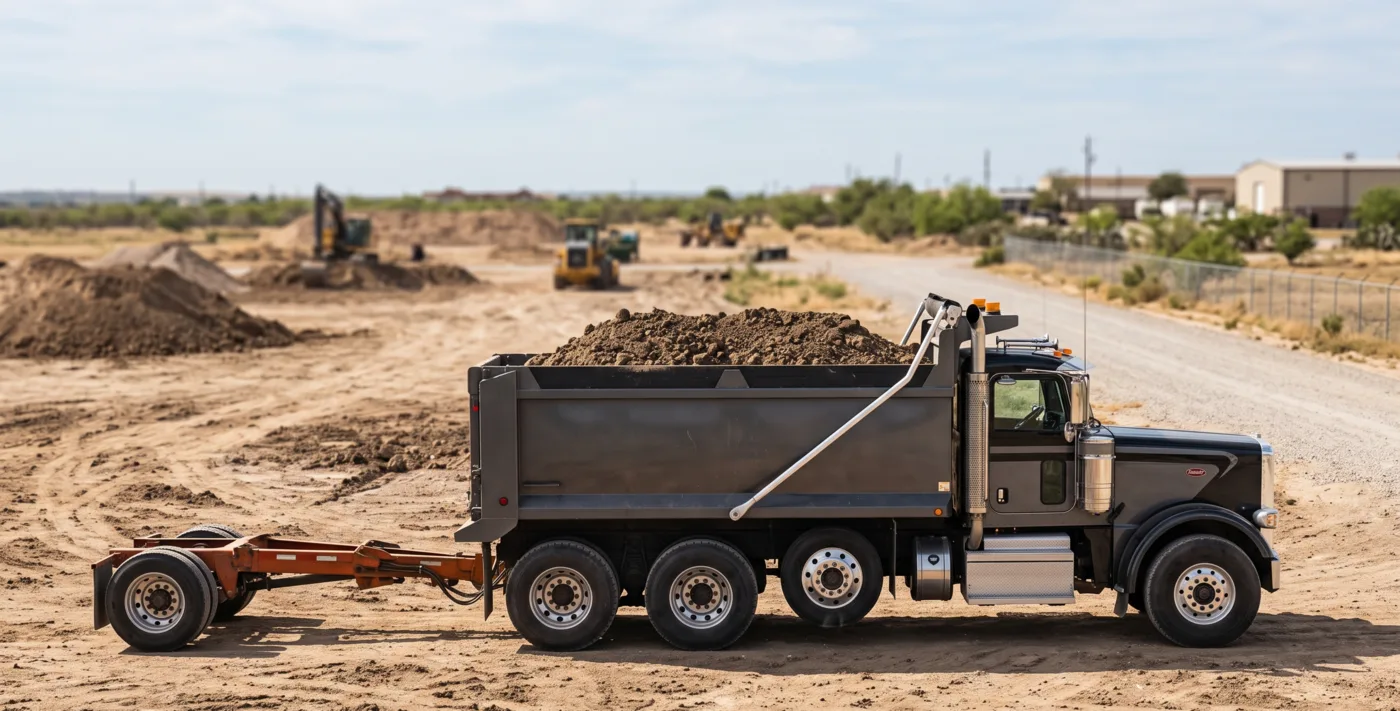
A super dump is a rigid dump truck fitted with a load-bearing trailing axle that reaches 11 to 13 feet behind the rear tandem and lowers to the pavement under load. That stretch rewrites the truck’s Federal Bridge Formula math, lifting its legal gross toward the 80,000 pound ceiling, so it carries 19 to 26 tons, near semi payload, while still dumping in place like a tandem. This guide covers how the trailing axle buys that payload, what a super dump carries, and where it wins. It is part of our complete guide to dump truck sizes and load capacity.
Key takeaways
- A super dump carries about 19 to 26 cubic yards or 19 to 26 tons, close to end dump payload from a rigid truck that dumps in place.
- The trailing axle reaches 11 to 13 feet behind the rear group and lowers under load, stretching the outer axle span the Bridge Formula measures.
- With enough axles over enough length, the formula allows up to the 80,000 pound federal gross ceiling, versus roughly 50,000 for a standard tandem.
- Empty, the axle lifts and the truck maneuvers like an ordinary straight truck.
- It is the payload-per-truck champion of in-place dumping, which is why paving and metro dirt fleets run them.
What a super dump is
Start with a heavy rigid dump truck, usually already carrying extra lift axles ahead of the rear tandem. Then add the signature piece: a trailing axle on a long boom that extends past the end of the bed and lowers its wheels to the road under load. The truck now spans far more pavement between its first and last axle than any conventional straight truck, and in the eyes of the weight law, that changes what it may carry. Raise the axle and it is a normal truck again: legal to maneuver, easy to load, still dumping its own bed in place.
The Bridge Formula, and why stretching pays
The Federal Bridge Formula sets the maximum weight for any group of axles as W = 500 times the quantity, L times N divided by N minus 1, plus 12 times N, plus 36, where L is the span in feet between the group’s outer axles and N is how many axles the group contains. Weight allowance grows with both. A standard three axle tandem spanning about 20 feet works out near 51,000 pounds. A super dump running seven axles across a 35 foot span computes past 80,000, so the truck is capped by the federal gross ceiling itself, not by the formula. The trailing axle exists to buy exactly that: length and axle count, purchased on demand.
The payload follows directly. Against a roughly 30,000 pound empty weight, an 80,000 pound gross leaves close to 25 tons of legal load, which is why the super dump’s 19 to 26 ton range brackets what a five axle end dump hauls, from a truck a fraction of its length.
Super dump at a glance
| Spec | Figure |
|---|---|
| Typical volume | About 19 to 26 cubic yards |
| Typical payload | About 19 to 26 tons |
| Axles | Up to 7, including lift axles and the trailing axle |
| Configuration | Rigid truck with a load-bearing liftable trailing axle |
| How it unloads | Raises its own bed and dumps rearward, in place |
| Best suited to | Maximum payload where the load must still land in place |
How many super dump loads is your project?
Divide your loose cubic yards by the truck’s capacity and round up, because a partial load still ships as a load. Order by loose yards, not compacted yards; fill shrinks under compaction, so a finished pad needs more loose yards delivered than its compacted volume.
| Project volume | Loads at 19 cy | Loads at 26 cy |
|---|---|---|
| 100 cubic yards | 6 loads | 4 loads |
| 250 cubic yards | 14 loads | 10 loads |
| 500 cubic yards | 27 loads | 20 loads |
| 1,000 cubic yards | 53 loads | 39 loads |
When the super dump is the right truck
High daily tonnage that must land in place: paving support, metro dirt work inside city limits, and production hauls where every truck on the route should carry the legal maximum but a raised semi trailer or a windrow will not do. One box, one driver, no trailer to stage, and a dump cycle as simple as a tandem’s.
It gives ground on rough sites, where the trailing axle wants decent running surface, and in truly tight yards where the tandem still rules. For two-box total volume a transfer carries more, and for spread placement the belly dump keeps the crown.
How we dispatch super dumps
Where a job’s tonnage profile earns the biggest in-place load, we plan super dumps across Dallas-Fort Worth, Austin, San Antonio, and Houston. Send the material, the yards, and the placement, and we quote the loads same day.
Super dump FAQ
Maximum tons, dumped in place?
When every load should carry the legal ceiling and still land in place, we quote super dump loads same day across DFW, Austin, San Antonio, and Houston.